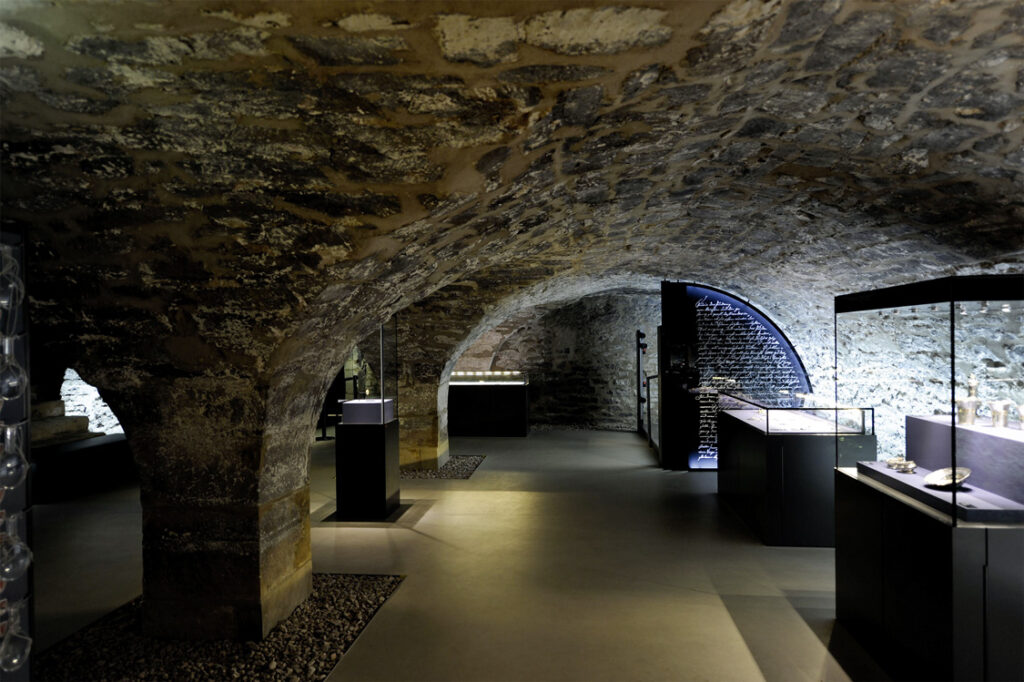
It glitters and flashes in the basement of the Old Synagogue in Erfurt. Here lies the famous Erfurt treasure, consisting of silver and Gothic goldsmith’s pieces that once belonged to the city’s Jewish population.
The Jewish community in Erfurt was one of the largest and most significant in the Holy Roman Empire, whose development began as early as the High Middle Ages. Today, the Jewish heritage in Erfurt is one of the most important cultural assets of the city.
History of the Jewish Community in Erfurt
The Jewish community was founded in Erfurt in the Middle Ages. The Jews did not settle in closed quarters, as in many other cities, but lived in the middle of the city. From the beginning of the 13th century a large Jewish community had developed. There was a synagogue, a mikva and a cemetery, the Jews paid their taxes to the archbishop of Mainz and were subject to his jurisdiction.
In 1349, in the time of the plague, the first persecution of Jews took place in the city. The townspeople accused the Jews of poisoning the town wells and thus being guilty of the outbreak of the plague. In a large-scale persecution of the Jewish population, they killed almost the entire community or expelled the families. The community was dissolved.
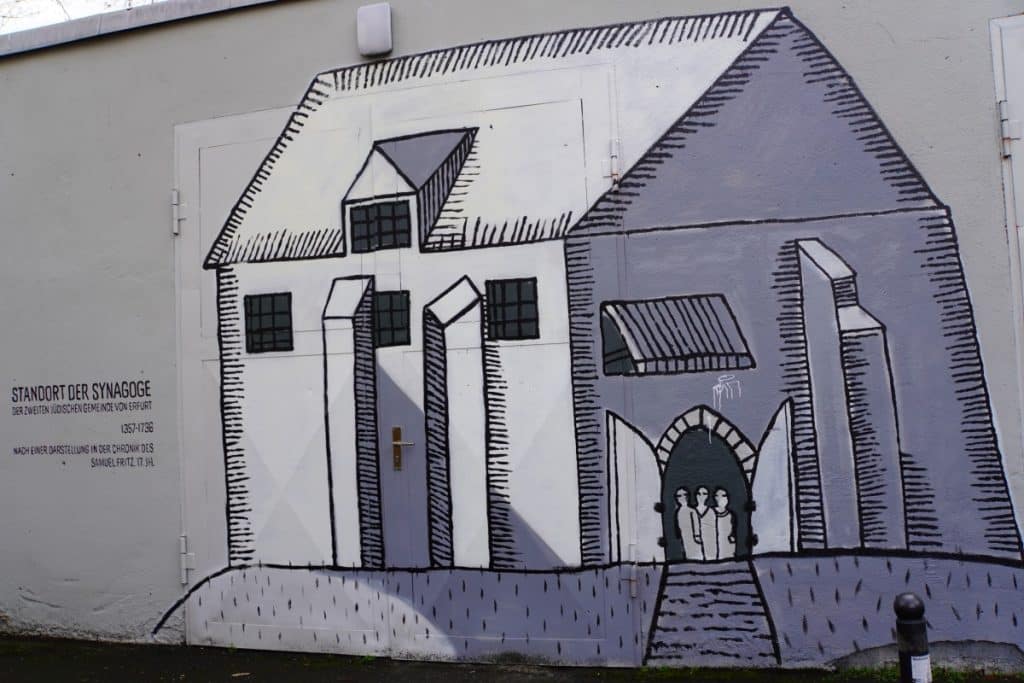
A few years later, in 1354, two Jewish families settled in Erfurt and founded the city’s second Jewish community. For a time, this developed into one of the largest in the German-speaking region. The coexistence of Jews and Christians in Erfurt was regulated by the city in several ordinances. These contained, for example, a dress code and the specifications for tax payments.
In the 1430s, the economic situation in the country began to deteriorate. The Jewish community was not spared from this either and an exodus of families began. Then, in 1453, when the city council announced that it would no longer provide protection for the Jews, the last families also left the city.
For many centuries, no Jewish family now lived in the city. Only when Erfurt was occupied by the French from 1806 to 1813 and later came under the Prussian government were they allowed to settle there again.
After 1933, many Jews in Erfurt were forced out of their professions and their property was “Aryanized.” Some left the city in time, but many other Jewish residents were deported by the Nazi state to various concentration camps from 1940-43.
Since the end of the Second World War, there has again been a Jewish community in Erfurt.
Discover Jewish heritage in Erfurt
During a tour of the city, I was able to discover some of the traces of the city’s Jewish history that remain in the cityscape to this day.
Small synagogue
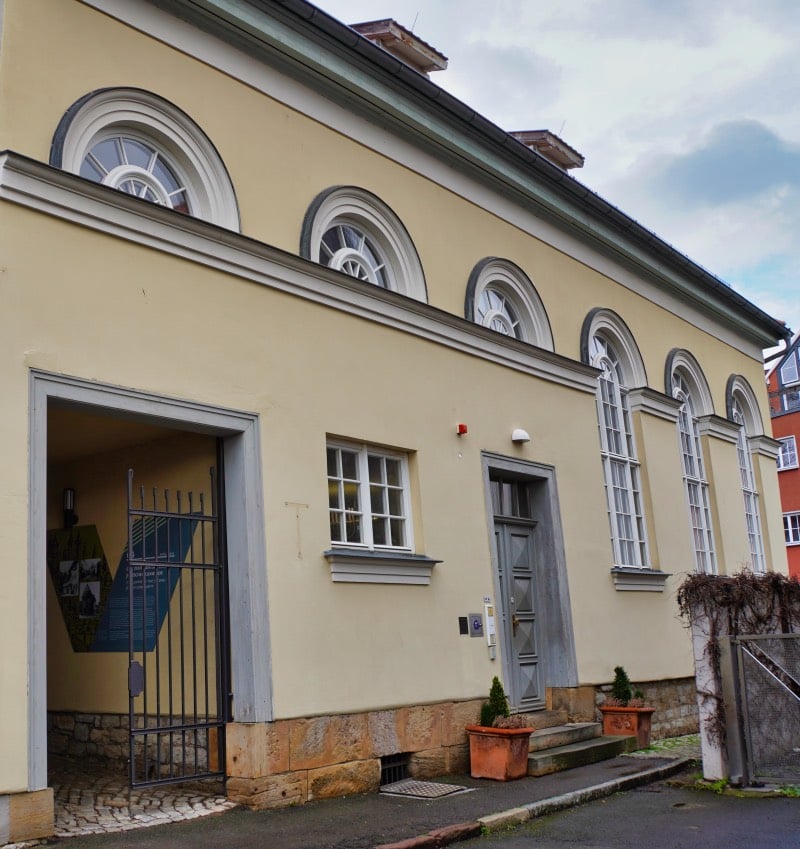
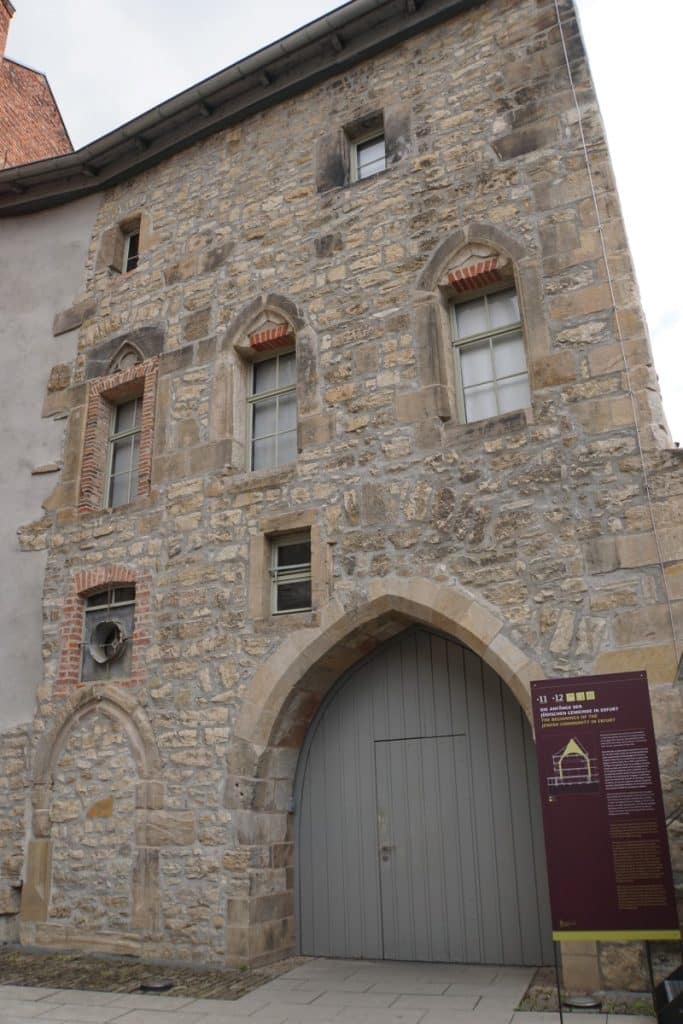
Behind the Erfurt city hall lies an inconspicuous building. In 1840, the Jewish community used this building as a synagogue. Today it is called the Small Synagogue.
Already in the second half of the 19th century, the Jewish community in Erfurt had grown so much that the existing place of worship had become too small. A new, larger synagogue was built on Kartäuserring.
The town sold the Small Synagogue to a merchant. The new owner used it as a distillery and warehouse.
In 1918, the city bought the building back and converted it into a residential building. This proved to be a good idea, as it allowed the building to survive the Nazi era unscathed.
In the 1980s, interest in Erfurt’s Jewish heritage grew. Building researchers found the mikvah, the Torah shrine and the women’s gallery during renovation work. The shrine and a door leaf were hidden under wall boarding and ceilings. Behind a load-bearing beam, a completely preserved Hebrew inscription (“Know before whom you stand”) was found. The mikvah in the Small Synagogue had been filled in and could only be discovered due to old building records. In 1994, workers uncovered the mikvah, which was made of sandstone. Seven steps lead down to the basin. The basin has a capacity of about 520 liters and is just under 1.45 deep.
In 1992, the Small Synagogue was listed as a historical monument. Today, the building houses a Jewish-German meeting center, which deals with the Jewish heritage in Erfurt and provides information about it.
Mikvah – the ritual bath
The mikvah is an important part of Jewish life. Mainly women use it for their traditional cleansing after touching the dead, blood or other things that are unclean according to religious belief.
Fresh water flows constantly into a mikvah. This is certainly one reason why there is a mikvah in Erfurt in the immediate vicinity of the Gera River.
It is known today that the history of this mikvah goes back to the 13th century. In written sources one can read that the Jewish community had to pay taxes for the bath and for the property. In the beginning these were paid to the bishop, later to the town.
From the first ritual bath only a wall is preserved today. Later, the community built a new building on this wall, which has been almost completely preserved until today.
The mikvah is part of the Jewish heritage in Erfurt. Water flows through the basin here to this day.
Old synagogue
The Old Synagogue is one of the most interesting places of Jewish heritage in Erfurt. The building is used as a museum, where you can learn not only the Erfurt treasure, but also information about the Jewish community of the city.
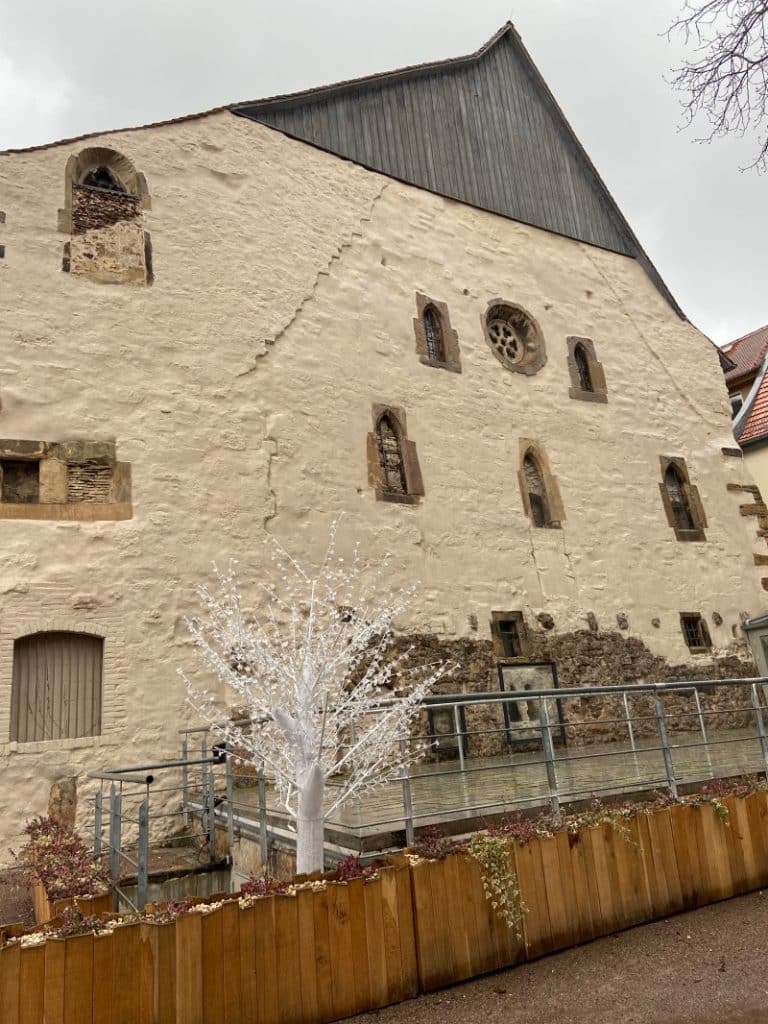
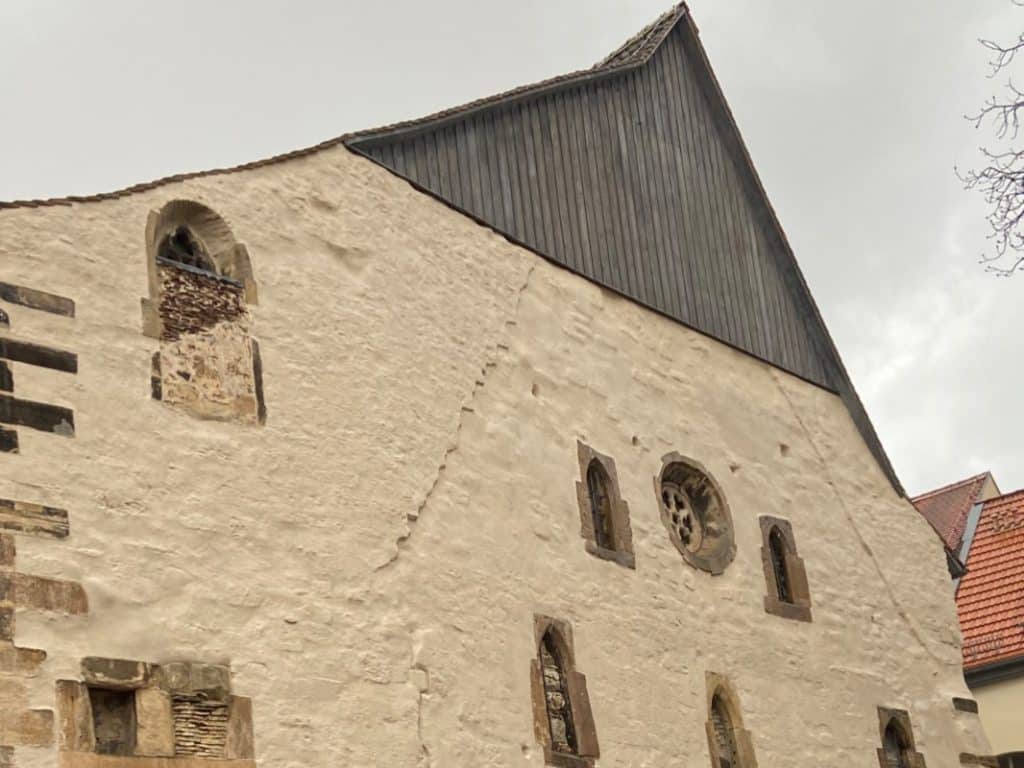
The oldest parts of the wall of the house of worship date back to the late 11th century and can be traced in the lower part of the west wall. At the end of the 12th century, the congregation rebuilt the synagogue. Here, too, traces can be found on the west façade. A twin window dates from this period.
Another phase of reconstruction can be dated around 1270. During this period, for example, the five lancet windows and a large window rose window were created. Inside the building, a high room with a wooden barrel vault formed the central meeting place. Today, one can still see a surrounding light cornice from this construction phase, on which oil lamps or candles were placed to illuminate the synagogue.
In 1349, a devastating pogrom occurred in Erfurt, during which the synagogue was severely damaged and the Jewish community was expelled from the city. The city took over the building and sold it to a merchant. After the building was profaned, the latter converted the place of worship into a warehouse. During these construction measures he created, among other things, two gateways for horse-drawn vehicles. The Torah shrine was also destroyed in the process.
For more than 500 years the synagogue was a warehouse. Then, in the late 19th century, the building was used as a dance hall on the upper floor and a gastronomic establishment. The operator furnished the dance hall with stucco figures and a colorfully painted surrounding gallery. This is still preserved today and makes the room something very special.
All the reconstructions of the past time made it almost impossible to recognize the synagogue still as a place of worship and so the original function of the building was almost forgotten. At the end of the 1980s, an institute for the preservation of historical monuments documented the building structure and brought the original function back into people’s memory. After tough negotiations with the owner, the city was able to buy the building back and renovate it. In doing so, it succeeded excellently in allowing the different uses to continue to be visible. Today, the synagogue is an interesting museum on the culture and history of Erfurt’s Jewish community in the Middle Ages.
Old Synagogue Erfurt exhibition room in the basement: Albrecht von Kirchbach, 2008
A special highlight of the museum is the Erfurt treasure, which is exhibited in the basement of the building. This is over 3000 silver coins, 14 silver ingots and over 700 Gothic goldsmith’s pieces, most likely buried during the pogrom of 1349.









Leave a Reply