Marrakech is one of the royal cities of Morocco. Here you can find relics from days gone by, such as the Bahia Palace and the El-Badi Palace. We visited both places and let us tell you this much – it is really impressive!
Visit Bahia Palace
In the second half of the 19th century, the Alawids ruled Morocco. The then Grand Vizier Si Moussa gave the order to build the palace.
At first the palace building was still quite small, only Moussa’s son, who had been appointed head of government by the sultan of the time, expanded the construction. He commissioned the master builder Mohammed bi Makki. His buildings are characterized by the Andalusian architectural style and this can be seen in the palace.
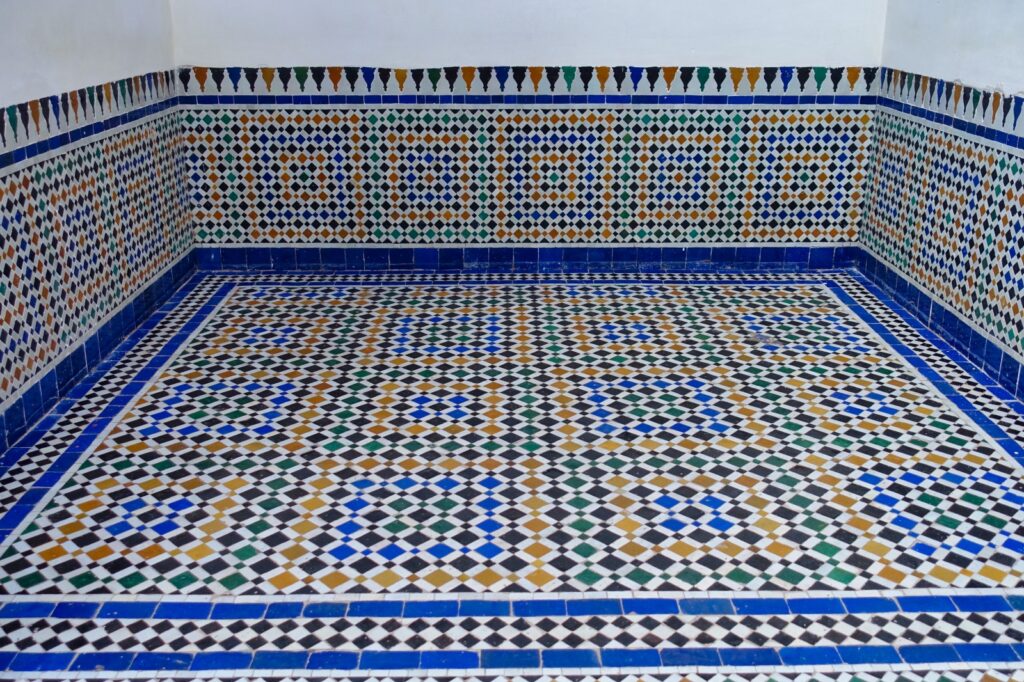
About 1000 workers needed over seven years until the largest palace of its time was completed. The necessary building materials were gathered from all over North Africa and the Italian marble came from Carrara.
The Grand Vizier Bou Ahmed died in 1900, and after his death they ransacked the palace and looted everything they could carry away.
During the period of the French protectorate, the French used the palace as an administrative seat. With the end of the colonial period, the palace became the property of the king and was gradually renovated.
Today, the Bahia Palace is one of the most important tourist destinations in Marrakech.
Tour through the palace
One thing to keep in mind when visiting Bahia Palace – you need some time. The signposted tour leads visitors through rooms, gardens and courtyards. Unfortunately, you will find almost no signs with explanations and whether you necessarily want to get involved with the “guides” in front of the palace, is such a thing. I would rather use a pre-booked offer of well-known tour providers. We have explored the Bahia Palace on your own and had so much time to look at the unusual architecture.
A wide path leads past ticket sales to an entrance door to the Bahia Palace. A maze of corridors, rooms and courtyards awaited us, which quickly brought me to the limit of my orientation.
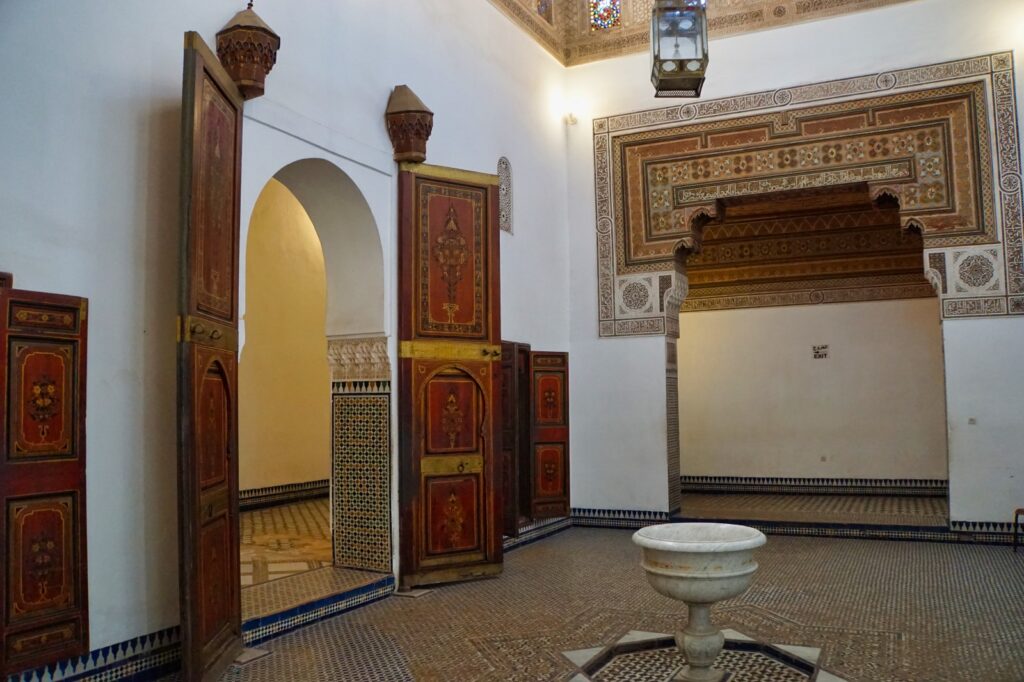
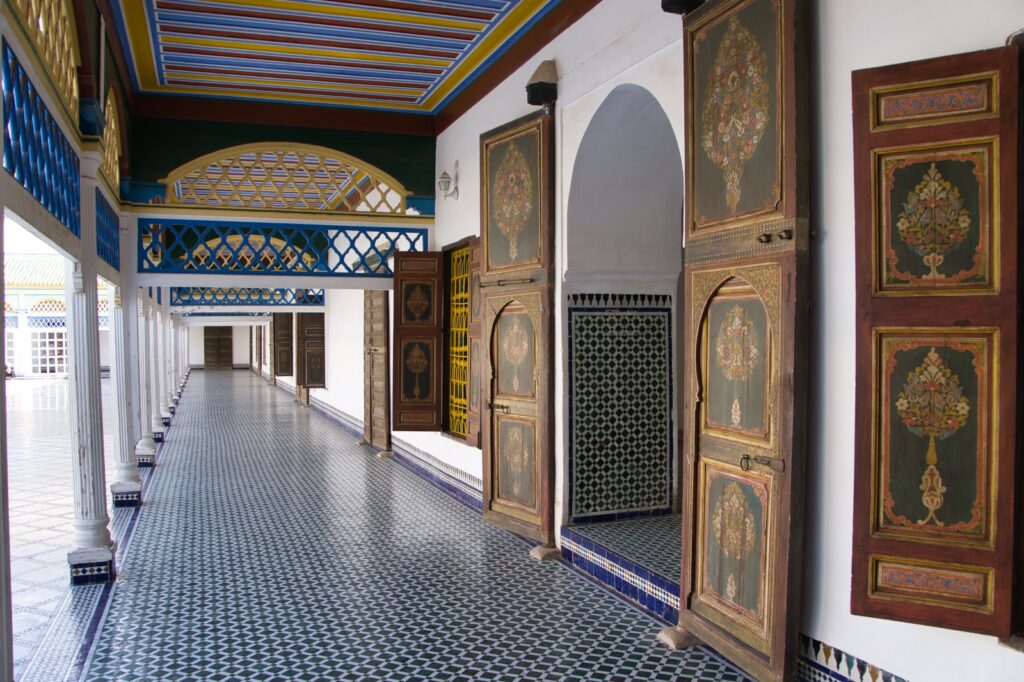
Almost all 160 rooms can be visited and all rooms are empty. I think that’s good, because if there’s no furniture that matches the style, you shouldn’t put anything in there that doesn’t fit. And to be honest, the rooms have a lot to offer even without furniture, you just have to look closely and direct your gaze to the ceiling!
The Bahia Palace consists of four parts, which we now explored bit by bit. The large riad dates from the first construction phase, later the small riad, the large courtyard and the garden and private apartment were built.
The small riad
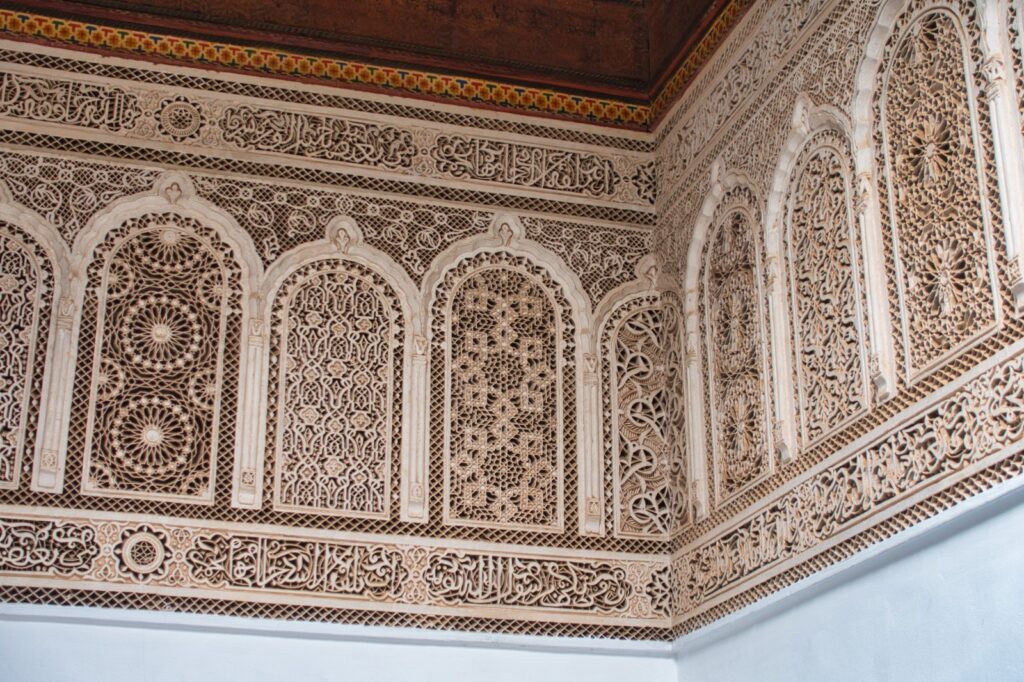
First we walk through the small riad that adjoins a square garden. Everywhere you can see cedar woodwork and carved stucco. Even without interior decoration, the small riad looks stately.
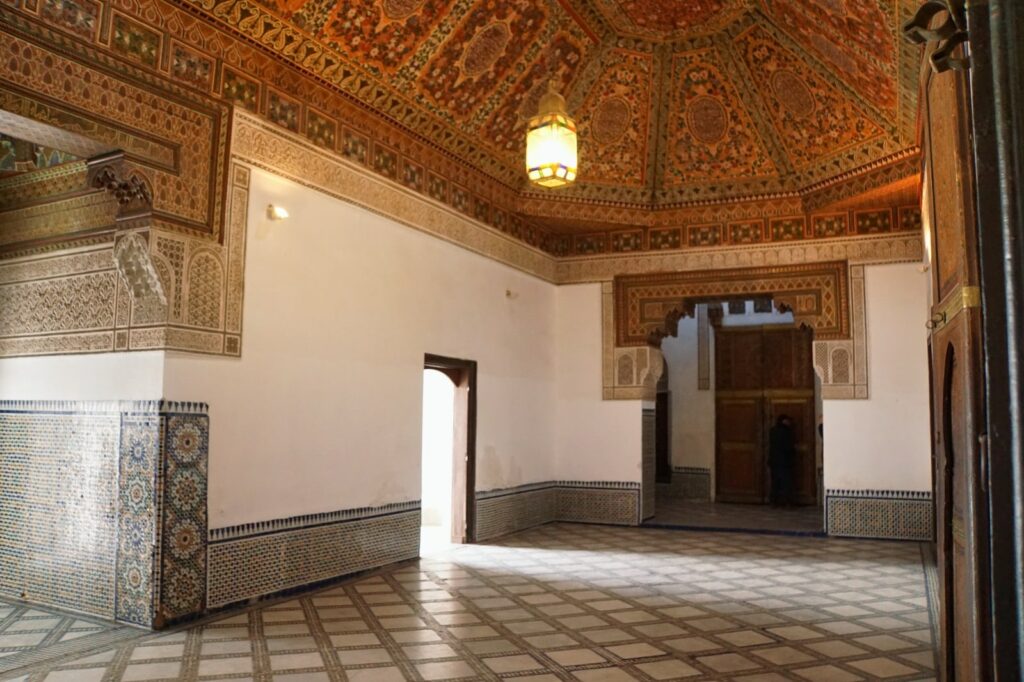
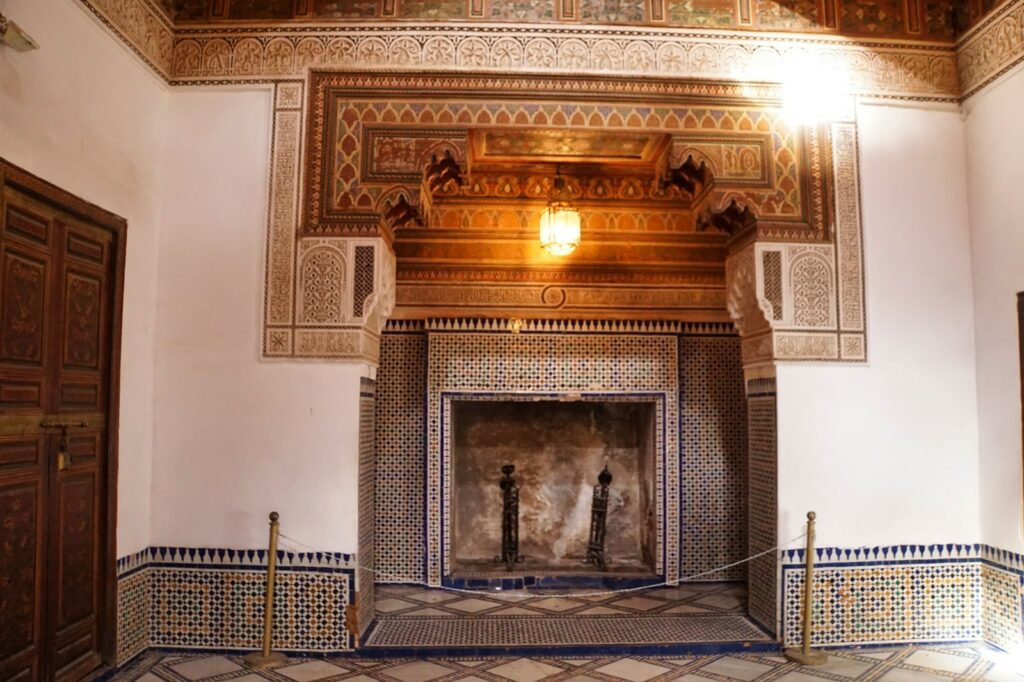
The fireplaces, which were installed here during the Protectorate period, are striking. Electricity was also put in the rooms at that time.
The small courtyard
Through some large rooms you get to the small courtyard. The floor is white Carrara marble. In the center is a fountain surrounded by tiled mosaics. We will encounter these mosaics again and again during our tour, they are typical of Morocco.
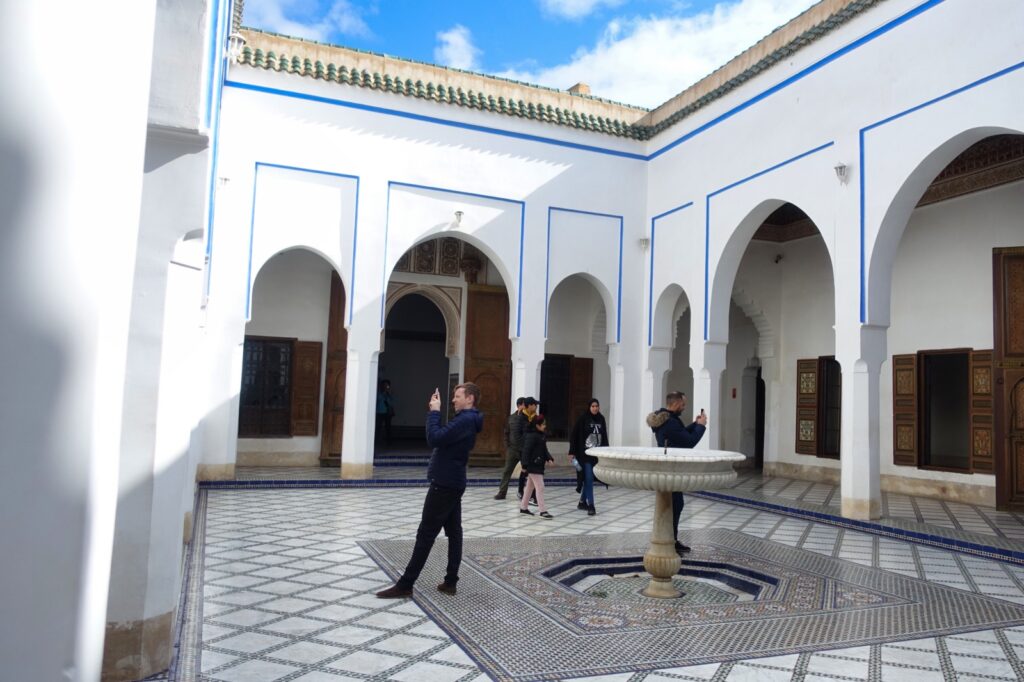
The courtyard is surrounded by four rooms.each room was inhabited by one of the four wives of the grand vizier.
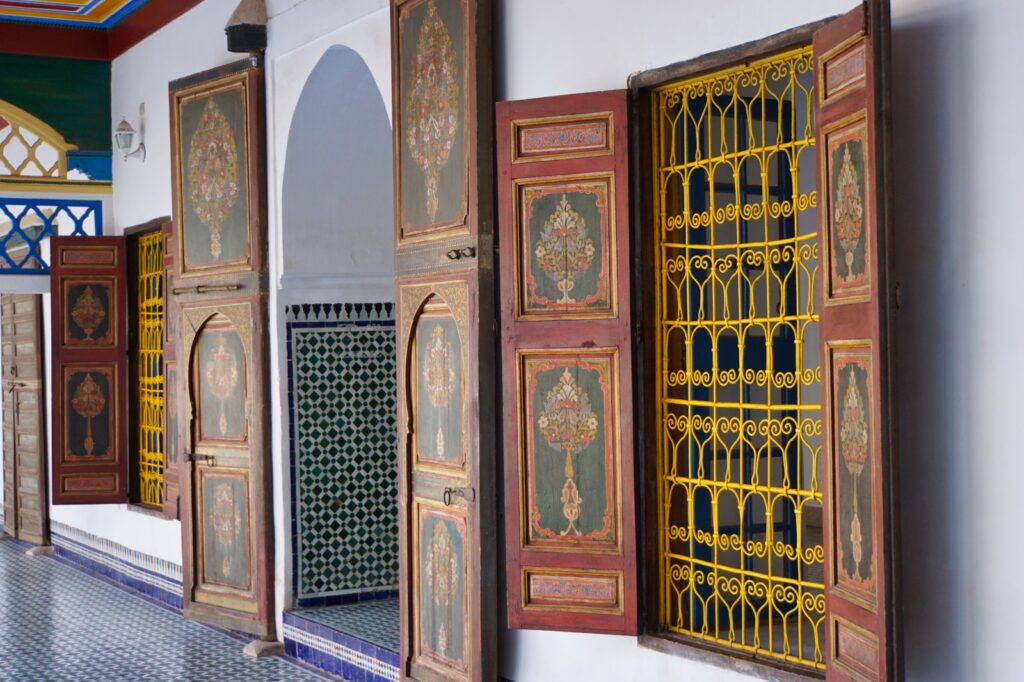
I find it striking that this area of the Bahia Palace seems rather plain. There are beautiful cedar ceilings and ornate doors, but otherwise there is hardly any decoration on the walls.
Court of Honor at Bahia Palace
Through a door one now enters the courtyard of honor. About 50 x 30 meters measures the large courtyard completed in 1898/99.
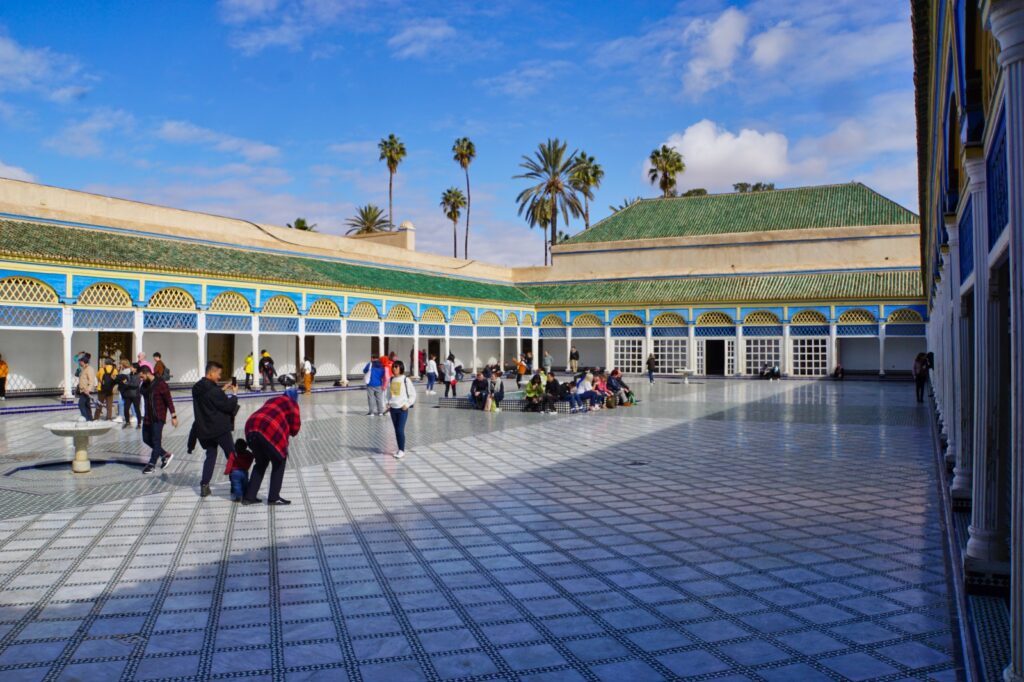
I am almost magically drawn to the courtyard, which is completely tiled in marble. The sun shines in and although it is only the end of January, the warm rays of the sun entice you to sit down on a step and let the courtyard of honor take its effect on you.
Around the courtyard runs an arcade from which some doors depart. At one corner you can see a bath, but the other doors are locked. Somewhere I read that rooms for the harem women were located here. Whether this is true, however, I do not know.
There is a large fountain in the center of the courtyard, with two smaller fountains in the extended sightline. I can imagine that the fountains provide the ideal cooling in the hot summer months.
Large Riad
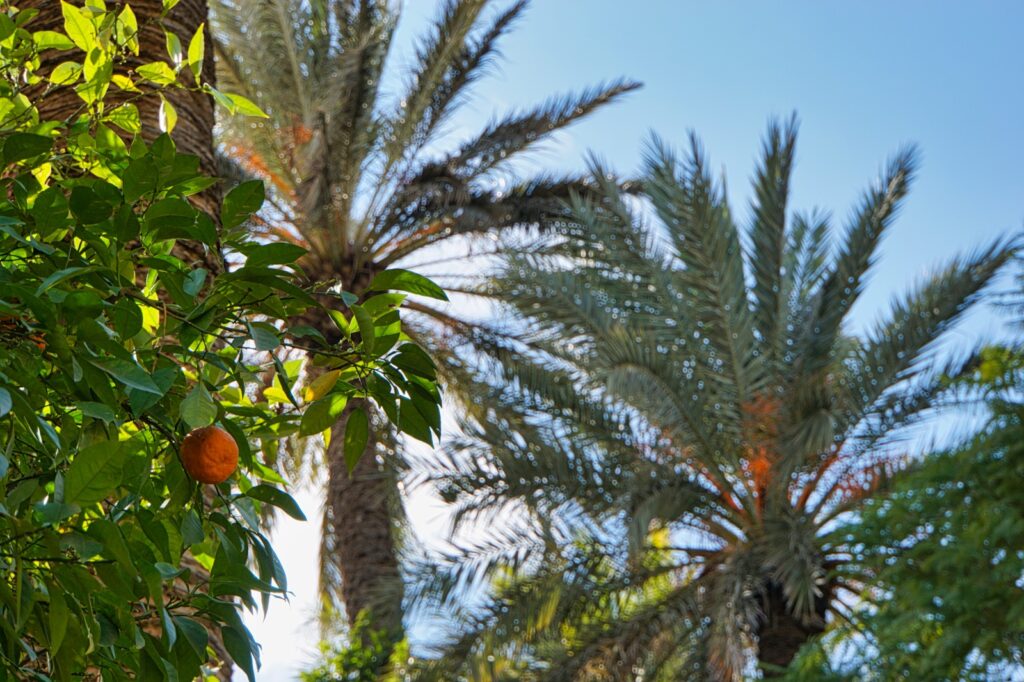
Through a door on the north side of the cour of honor, you enter the oldest part of the palace, the large riad. Here is a garden with palm trees, orange trees and small paths – a cool and shady place to linger.
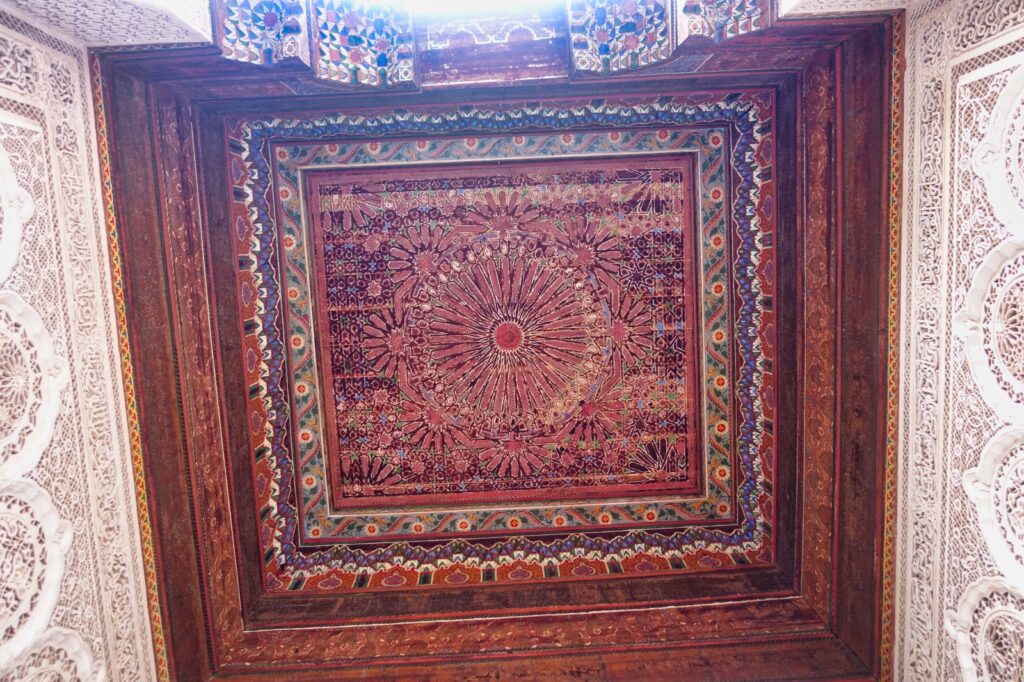
From the garden, one enters two large halls. Here I notice again the beautifully crafted cedar ceilings, painted with filigree patterns. I would love to see how these ceiling works are made or restored. They must have been true artists at work there. I have the feeling that no two ceilings are alike.
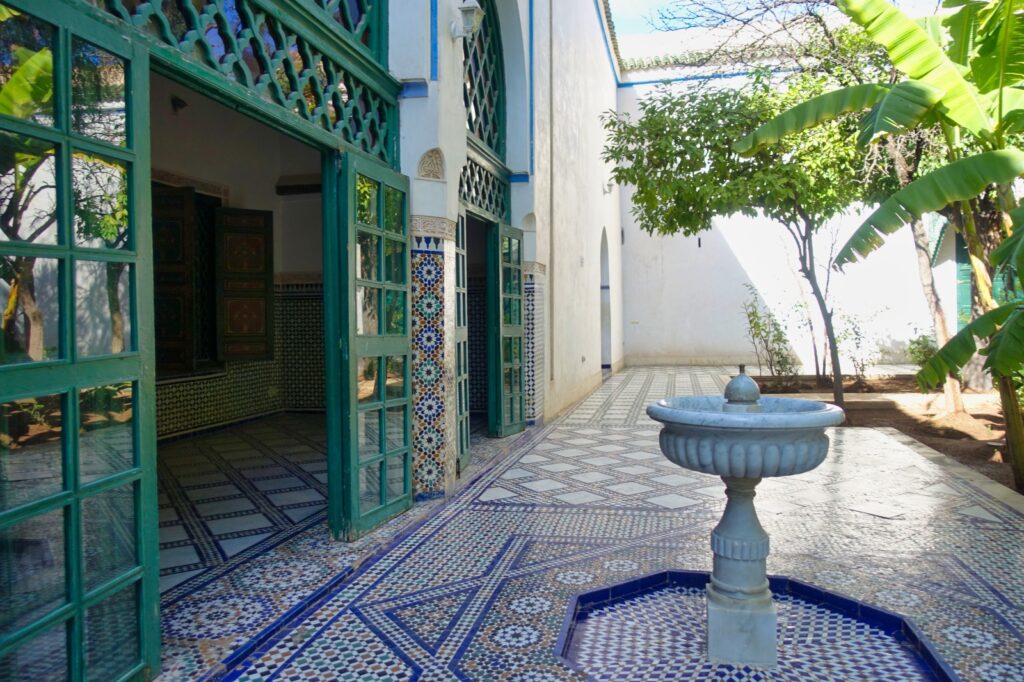
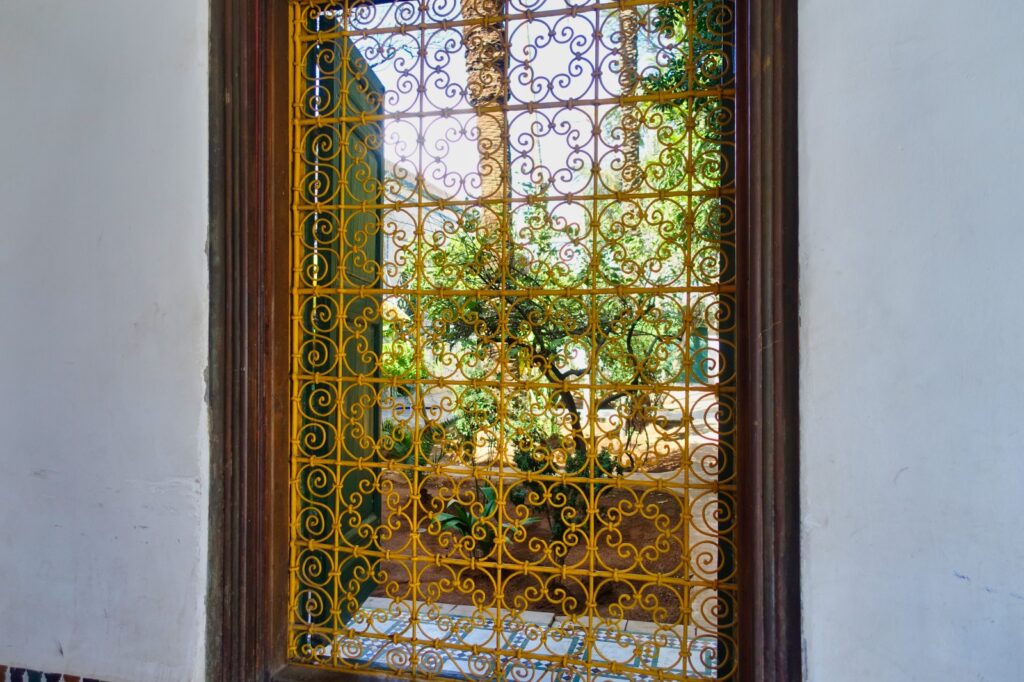
After our first exploration of the riad, we discover somewhat hidden the indication of the further course of the tour. We followed the sign and arrived in the small private apartment, which was created for the first wife of Bou Ahmed. Here, the stained glass windows in particular catch my eye, which with the right light irradiation certainly create beautiful lighting effects in the rooms.
Through narrow corridors that wind almost zigzag through the Bahia Palace, you finally get back to the starting point of the tour.
Bahia Palace film location
Such a wonderful palace complex is naturally also suitable as a film location. Some producers received filming permits and so scenes for the films “The Desert Lion”, “Lawrence of Arabia” (1962) and Cent mille dollars au soleil ($100,000 in the sun from 1964) were shot here.
Address:
Rue de la Bahia
Opening hours:
daily 9:30 – 17
Entrance fees:
adults: 70 MAD
Visit El-Badi Palace
In the southern part of the medina are the impressive ruins of the El-Badi Palace.
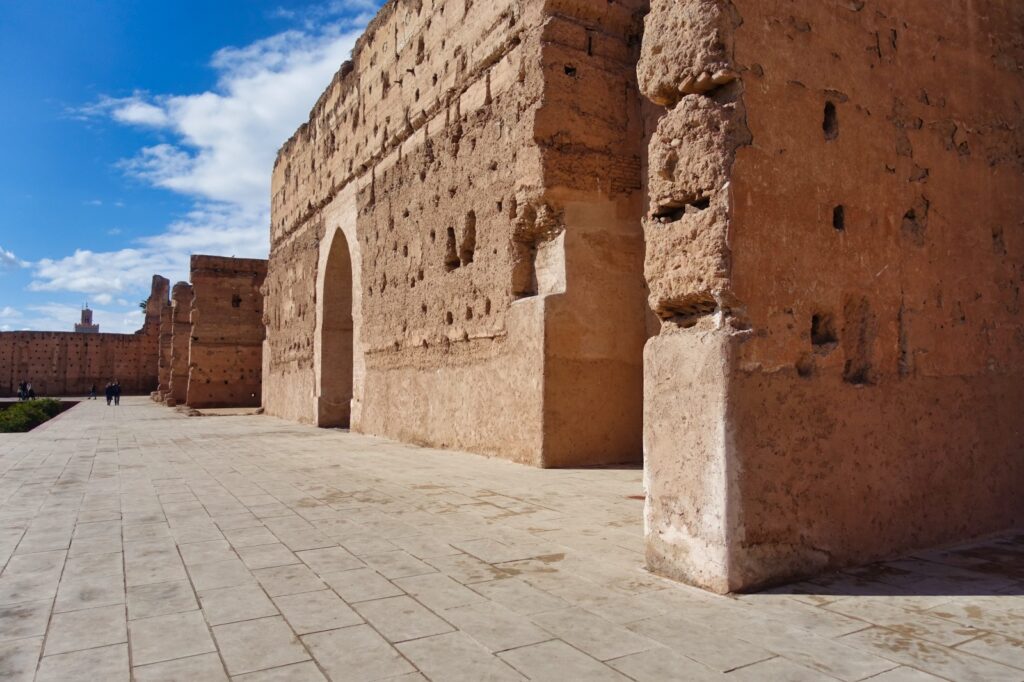
Sultan Ahmed El-Mansour had the El-Badi Palace built from 1578 to 1608. The result was a complex that was probably unparalleled at the time – large and indescribably beautiful. The walls were decorated with magnificent tiles, the floors were designed with elaborate mosaics and ornate cedar wood carvings characterized the ceilings.
Unfortunately, the splendor only lasted barely 100 years. The new Alaouite ruler Moulay Ismail moved his seat of power from Marrakech and built a palace in Meknes. The building material for it came from the El-Badi Palace. He simply had everything, except for the outer walls, torn down and built into his palace in Meknes.
Tour of the palace ruin
When touring a palace ruin, it’s always a question of whether it’s even worth walking around among the remains of the walls. With these ruins I have to say – it is definitely worth it!
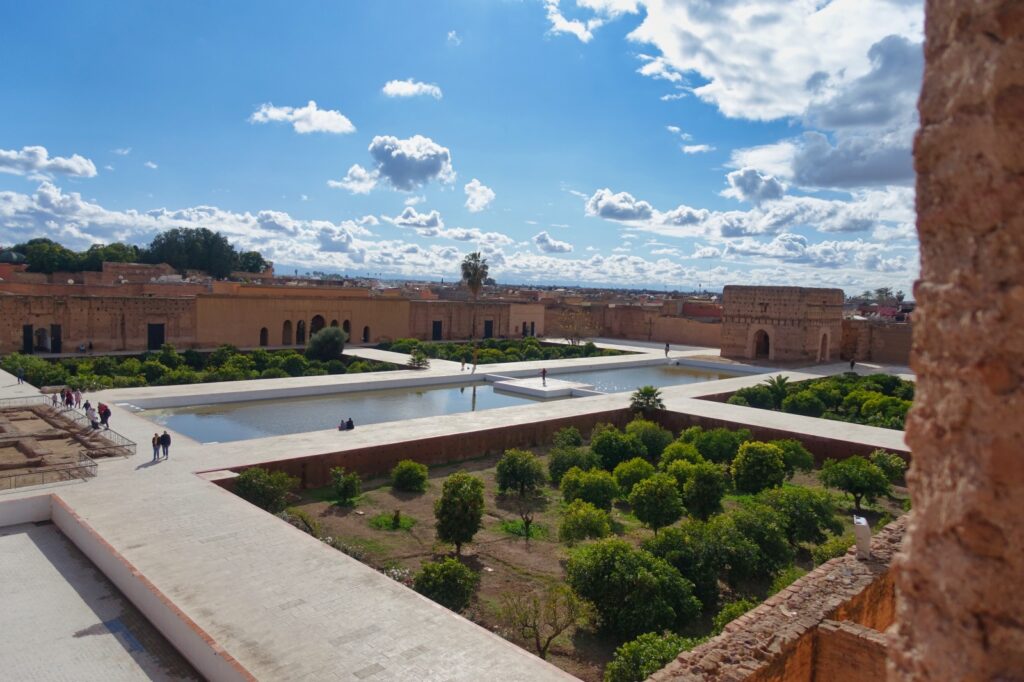
Through a gate we enter a large interior. The first thing that catches my eye are two lower gardens with orange trees. A light scent of oranges reaches my nose and I would like to eat a freshly harvested fruit now.
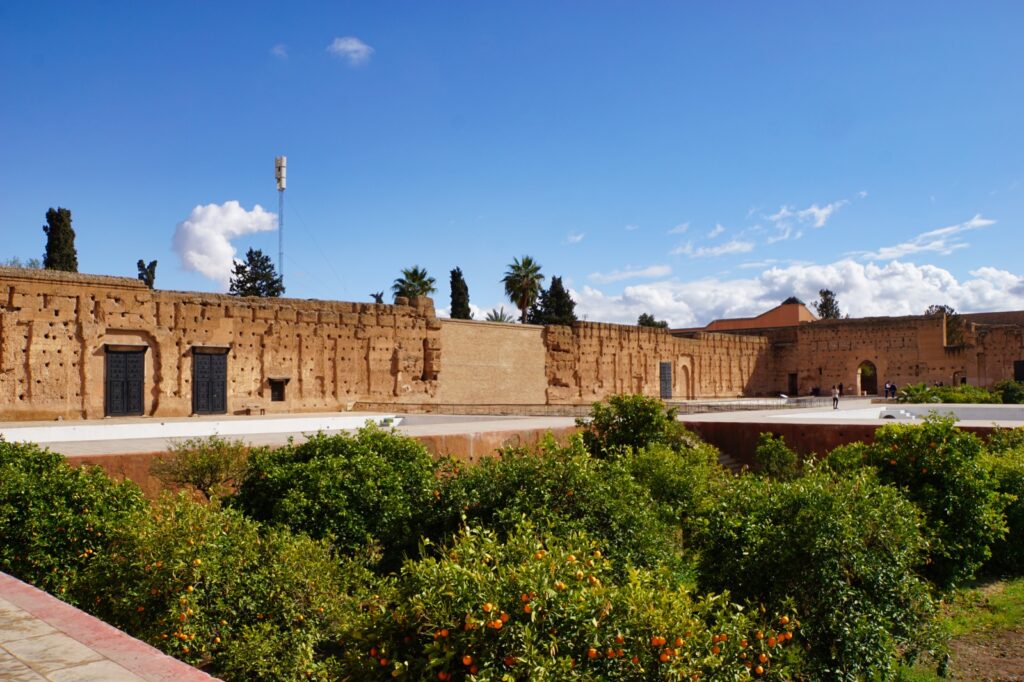
Next, we stand in front of a huge water basin. Now I would have liked to see the old buildings. It would certainly have been very interesting to look at the interaction of the architecture. I find the size of the basins impressive when you consider that they were located in the middle of a palace.
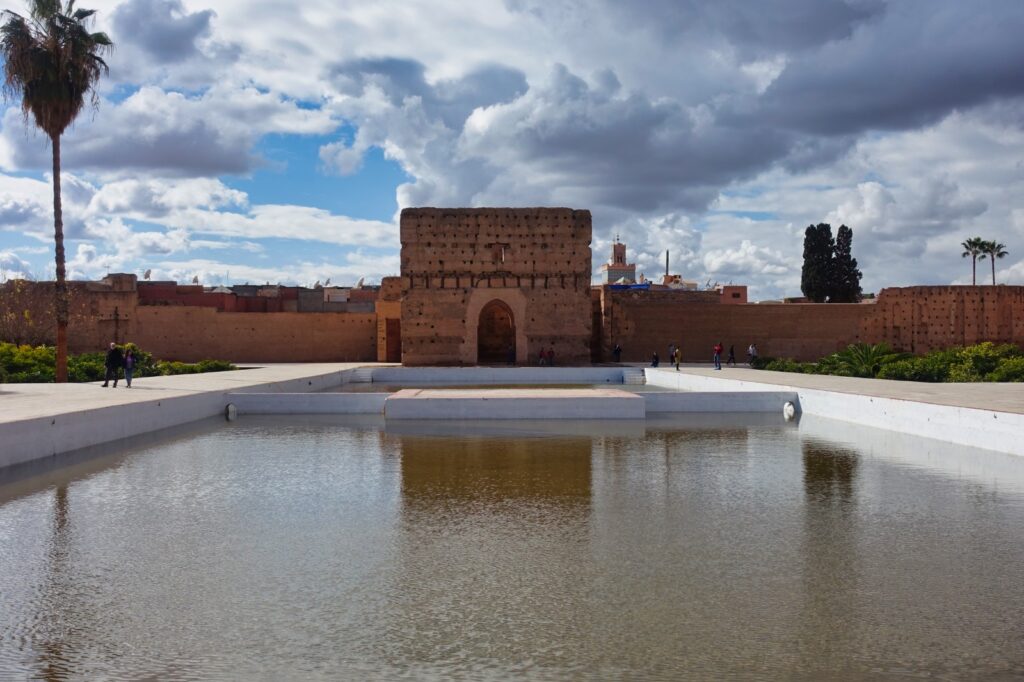
In one corner of the complex, a staircase leads to the vaults of the complex. Here were once the service rooms and also the dungeon is said to have been here.
At another point, we discover a room in front of which security personnel are standing and signs indicate that photography is prohibited. Here is a wooden prayer pulpit from the Koutoubia Mosque. The pulpit was built in Cordoba (Spain) in 1137 and is really very impressive.
Do not forget to visit a terrace. The stairway is located in a corner of the old palace complex. Over well-trodden steps you reach a viewing platform, which not only allows a view over Marrakech, but also the palace complex can be admired well from above.
Storks – storks everywhere
Something I found really beautiful and it elicited some “oh look…” and “ahs and ohs” from me.
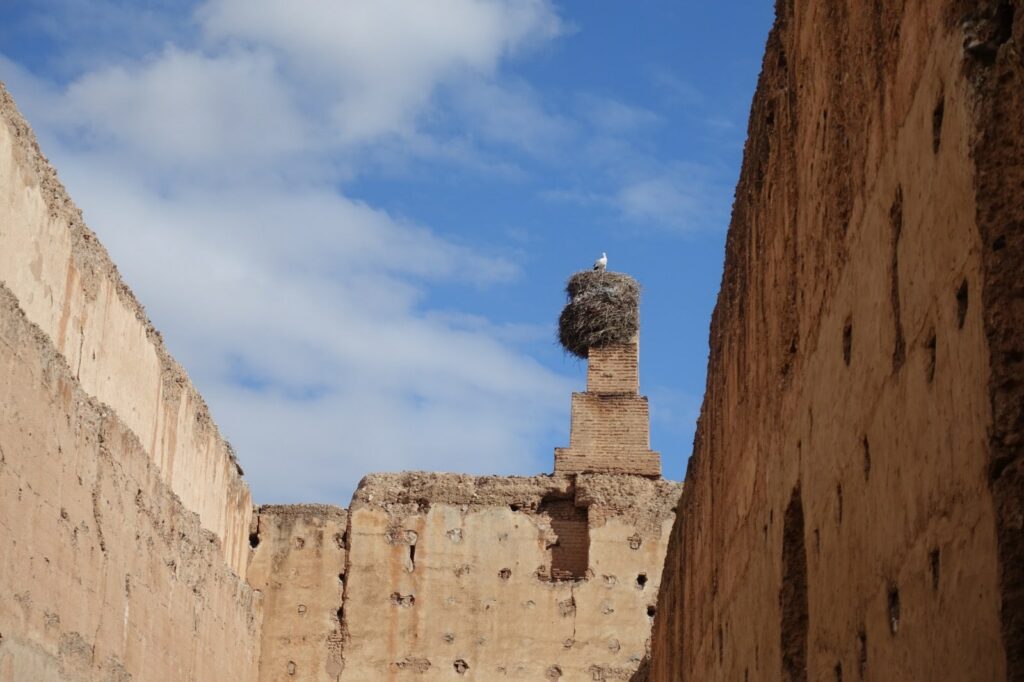
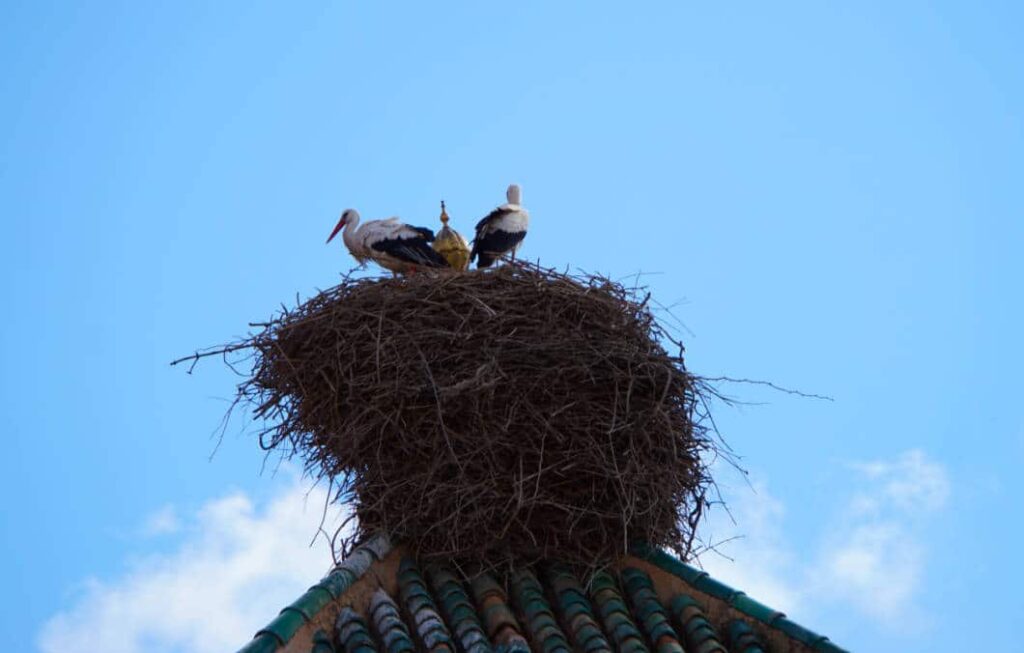
Storks nest everywhere on the large clay walls of the El Badi Palace. Not a pair of storks, no really many nests can be discovered. It is especially beautiful when a stork makes its rounds above the old palace complex and then turns off and flies over the medina of the city. I as a city dweller am not used to such a sight and watched the stork flight with enthusiasm.
Address:
Ksibat Nhass,
Marrakech 40000,
Opening hours:
daily: 9.30 -17
Entrance fees:
adults: 70 MAD

Leave a Reply