You can see the Koutoubia Mosque from almost every square in Marrakech. It is one of the main sights of the city and so we also walked past the mosque during a stroll through Marrakech.
Origin of the Koutoubia Mosque
The first Almohad caliph began building the mosque in 1147. He chose the exact spot where the palace of the previous dynasty, Ksar el-Hajar, had stood.
Shortly before its completion, it turned out that the qila wall (indicating the direction of prayer) was misaligned. The building was demolished again and replaced by a new structure in 1157. The pillars and wall foundations can be seen today on the north side of the mosque.
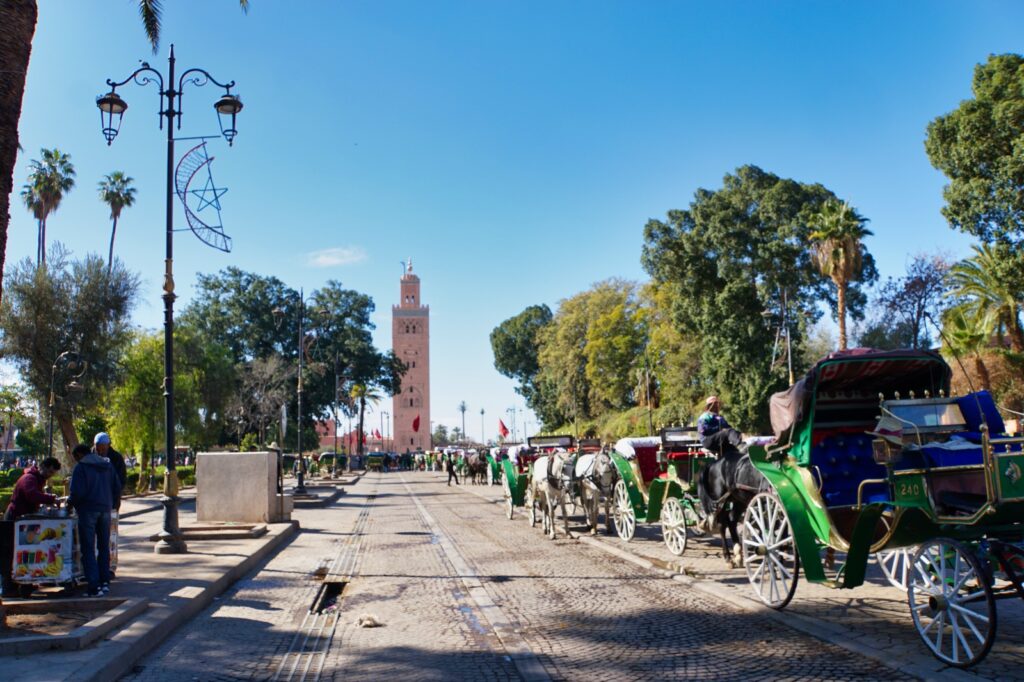
When the mosque was inaugurated in 1158, there was no minaret on the mosque. The tower was not completed until 1199.
The Koutoubia Mosque is considered the oldest mosque in all of Morocco. The name translates as “mosque of the booksellers” and refers to the souk of the booksellers, which was in the immediate vicinity.
Construction of the mosque
The mosque is built almost entirely of rammed earth and stands freely a little away from the medina. It is surrounded by palm gardens.
The building is about 90×60 metres and it is said that about 25,000 worshippers can gather there. The prayer room is a pillared hall with 17 parallel longitudinal naves and 7 transepts.
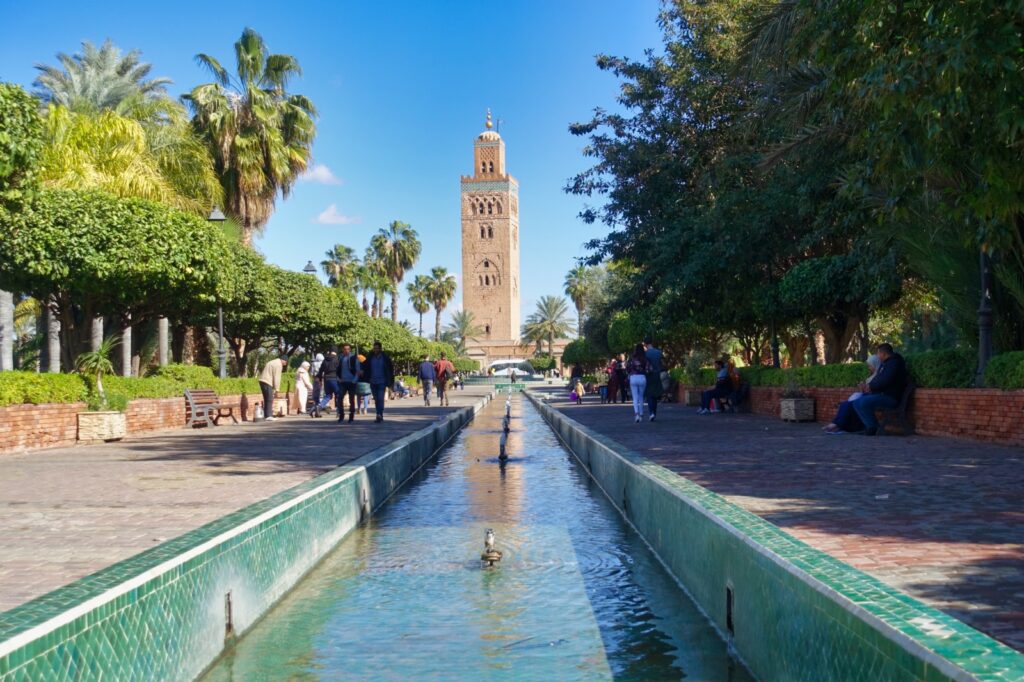
The minaret is a 77-metre-high tower made of sandstone blocks. The window openings in the tower are offset. This is because sloping ramps run around the inside to form the path to the top of the tower. It is said that until the introduction of loudspeaker systems, the muezzin rode up this ramp on horseback to call for prayer several times a day.
There is a platform at the top of the tower. This is surrounded by a circumferential parapet, which is visually characterised by a greenish tile mosaic about 2 metres high and a crenellation.
The lantern top of the minaret forms the end of the tower. It is visually identical on all sides. Here, too, a tile mosaic forms the upper finish. A gilded ball bar stands on the top and a “gallows” is attached to the side. In former times, the green flag of the Prophet was hung on the “gallows” for Friday prayers and on holidays. The meaning of the balls is not quite so clear. They are said to symbolise the three most important Arab mosques, the Al-Haram Mosque in Mecca, the Prophet’s Mosque in Medina and the Al-Aqsa Mosque in Jerusalem. But it is also said that the three spheres stand for the three elements of life: water, air and fire.
Can you visit the Koutoubia Mosque?
In Morocco, non-Muslims are not allowed to enter a mosque. The exception is a mosque in Casablanca.
This ban dates from the time of French colonisation in the 20th century. Hubert Lyautey, was Resident General in Morocco in 1912. He advocated the policy of segregation. He tried to enforce a spatial and cultural separation of the native Moroccans and the French colonists. He had extra residential and business quarters built for the Europeans and forbade non-Muslims to visit Moroccan mosques by law.
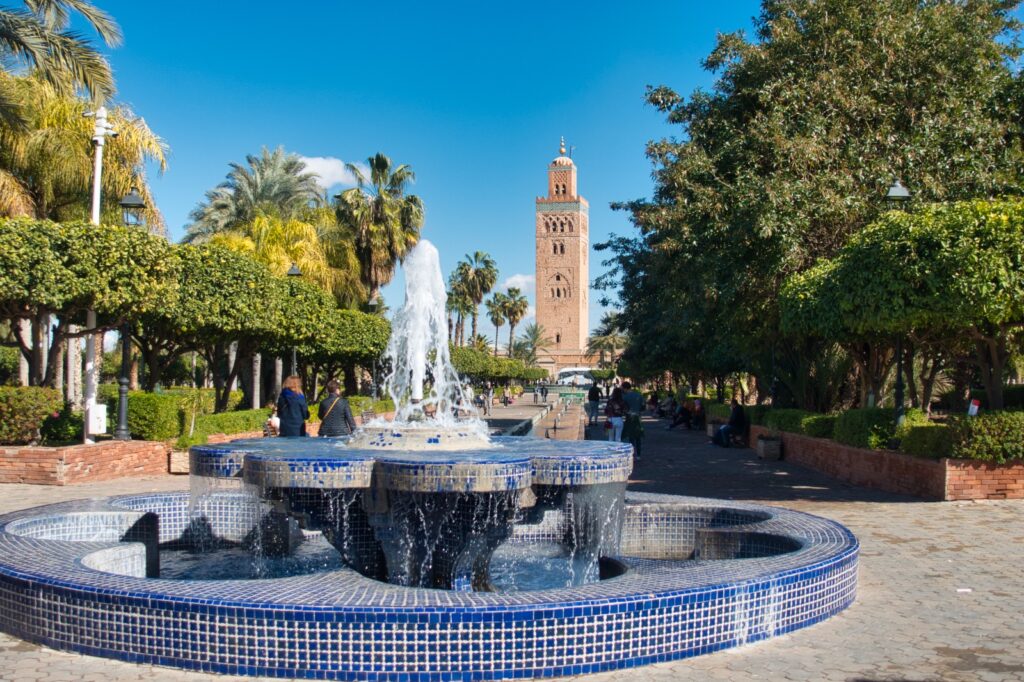
Even though the Koran only stipulates this rule for the holy mosque in Mecca, this prohibition has not changed until today. So we could not visit the Koutoubia Mosque from the inside, but only look at the impressive building from the outside.
Address:
Medina Jamaa El Fena,
Marrakesh

Leave a Reply