• Skip to content
  • Home
  • Destinations
    • Europe
    • Asia
    • Africa
    • North America
  • Germany
    • Baden-Württemberg
    • Bavaria
    • Brandenburg
    • Berlin
    • Bremen
    • Hamburg
    • Hesse
    • Lower Saxony
    • Mecklenburg-Western Pomerania
    • North Rhine-Westphalia
    • Rhineland-Palatinate
    • Saxony
    • Saxony-Anhalt
    • Schleswig-Holstein
    • Thuringia
  • Home
  • Topic
    • Breweries, beer, beer tours
    • Wine, wine tasting, wine hikes
    • Hiking in Germany
    • UNESCO Sites in Germany
    • City passes
    • Airlines & Airports
    • River Cruises
    • Cruises
    • Christmas markets
  • Search
  • Deutsch
  • English (UK)
Destinations › Morocco › Marrakech

Saadian Tombs – one of the most important sights in Marrakech

We roam through the south medina of Marrakech and arrive at the Kasbah Mosque near the city gate Bab Agnaou. Here are the world-famous Saadian tombs, which we were eager to visit during our stay in the city.

The entrance to the tomb is rather inconspicuous and if there had not been a sign showing the way, we would certainly have walked past. You walk through a narrow corridor and reach an impressive tomb complex, which was originally used “only” as a garden of the mosque.
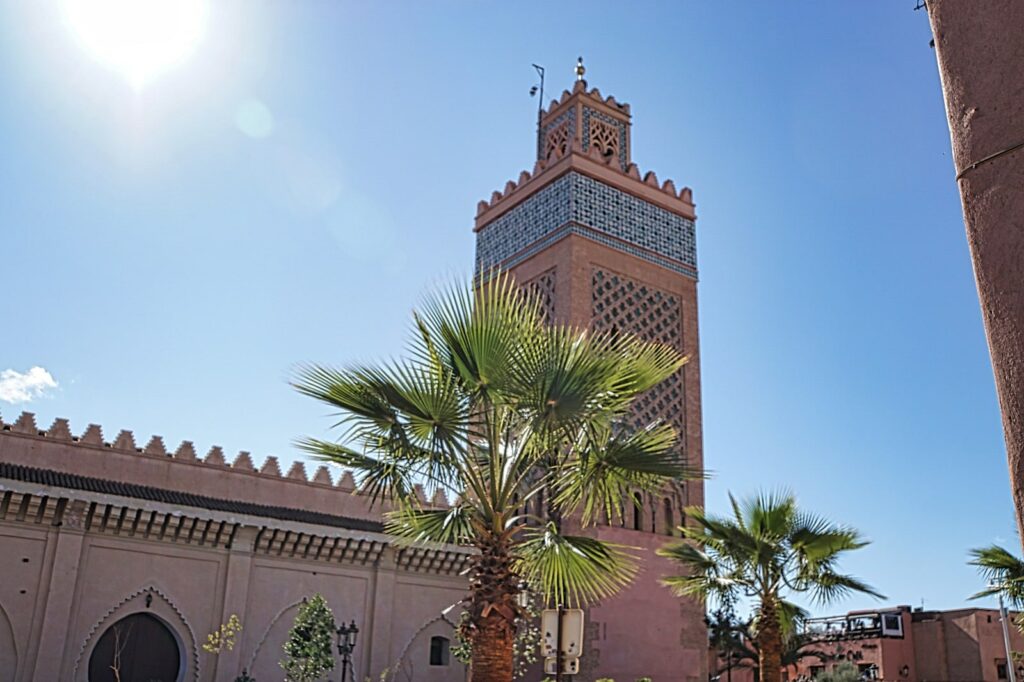
A low-angle view of the Saadian Mosque in Marrakech, featuring its tall, ornate minaret decorated with geometric patterns and blue tiling under a bright, sunny sky. Palm trees stand in the foreground against the mosque's reddish-pink walls and crenelated roofline.

Interesting facts about the Saadian tombs

As already mentioned, the site of the tomb was actually a garden of the neighboring mosque. Even before that, some emirs and the Merinid Sultan Abul-Hasan are said to have been buried here. During the reign of the Saadians (from 1557), the first Saadian sultan was buried in the garden. His son had a tomb built and was later buried there as well. This is how the tomb complex, known today as the Saadian Tombs, came into being.
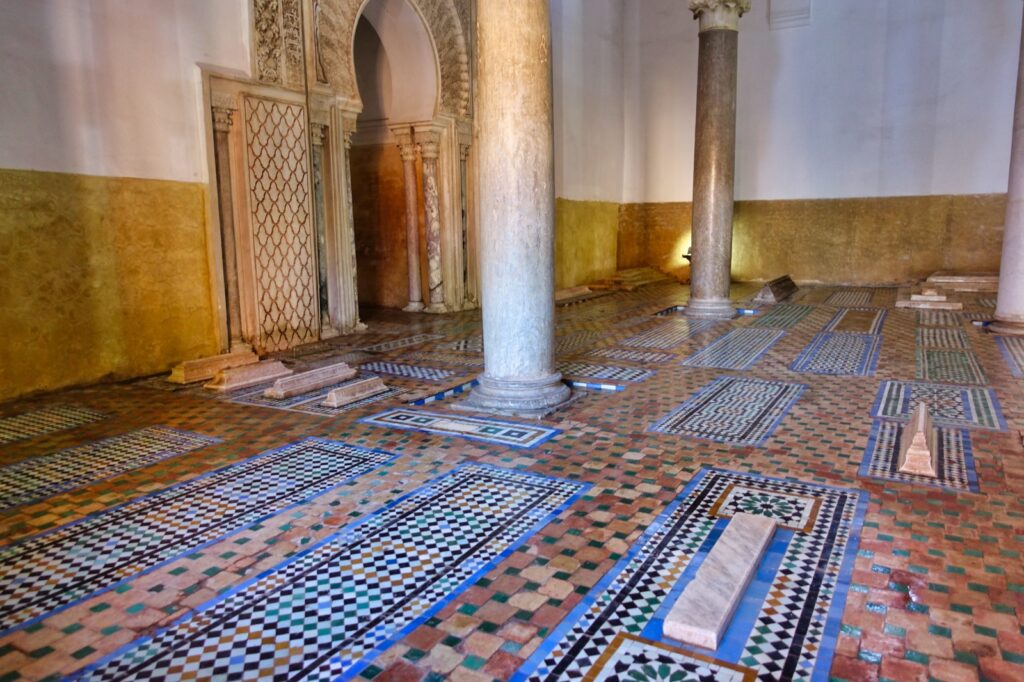
The Saadian Tombs in Marrakesh feature a chamber with intricately tiled floors and marble columns, where small, decorative grave markers indicate the burial sites of children.

In the late 16th century, some more people were buried here and more mausoleums were built, which have been used for over 200 years. Alawid Sutan Mulai Ismail wanted to bring the memory of the Saadian dynasty into oblivion. He surrounded the area with high walls. Apparently, he succeeded quite well. It was not until 1917 that the site was found again by chance. Graves of seven sultans and 62 members of the families were discovered. About 100 other graves are additionally spread over two mausoleums and the courtyard.

What can you see at the Saadian tombs?

Stepping through the narrow corridor that brings you to the tomb, you stand in a beautiful leafy courtyard.

Great mausoleum

Just to the left of the entrance is the great mausoleum. Here there is a door through which you can look into a large hall the “Hall of the Twelve Pillars”. When we were there in January, we had to wait in line for about 15 minutes before we could take a look inside the mausoleum.
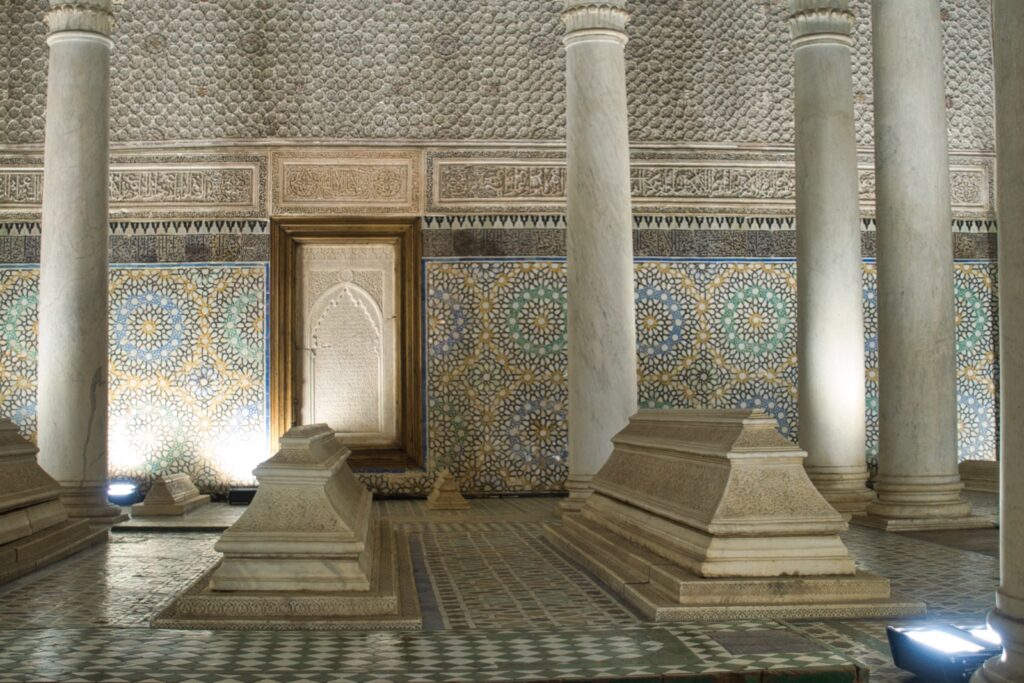
The Chamber of the Twelve Columns in the Saadian Tombs of Marrakesh features ornate marble tombs and intricately carved stucco walls with geometric zellij tilework. Tall Carrara marble columns support the vaulted ceiling of this historic mausoleum, which is illuminated by soft ground lighting.

The hall of the twelve columns is square. My first look was upwards, because here is a dome carved from cedar wood, supported by columns of Carrara marble. The floor in the mausoleum is covered with mosaics. In the burial chamber are coffins of several Saadian sultans with their family members.
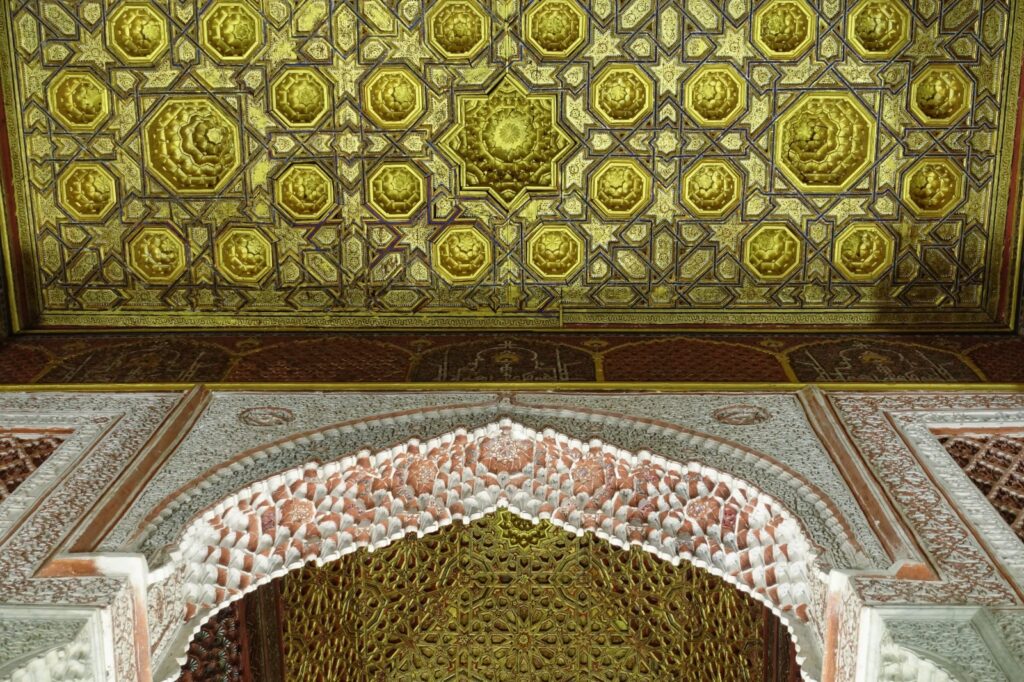
An intricate, gilded wooden ceiling with geometric star patterns and octagonal carvings adorns the Saadian Tombs mausoleum in Marrakech, seen above a scalloped arch with detailed plasterwork.

I have to admit, in retrospect, this room was really impressive. I only felt a little “rushed” on site, because behind us also so some visitors were waiting to be able to take a look into the room. So I could look at the room of the twelve columns only briefly. The carvings, the mosaics and the marble give the room a “1000 and one night” character – it seemed to me almost like a movie set.
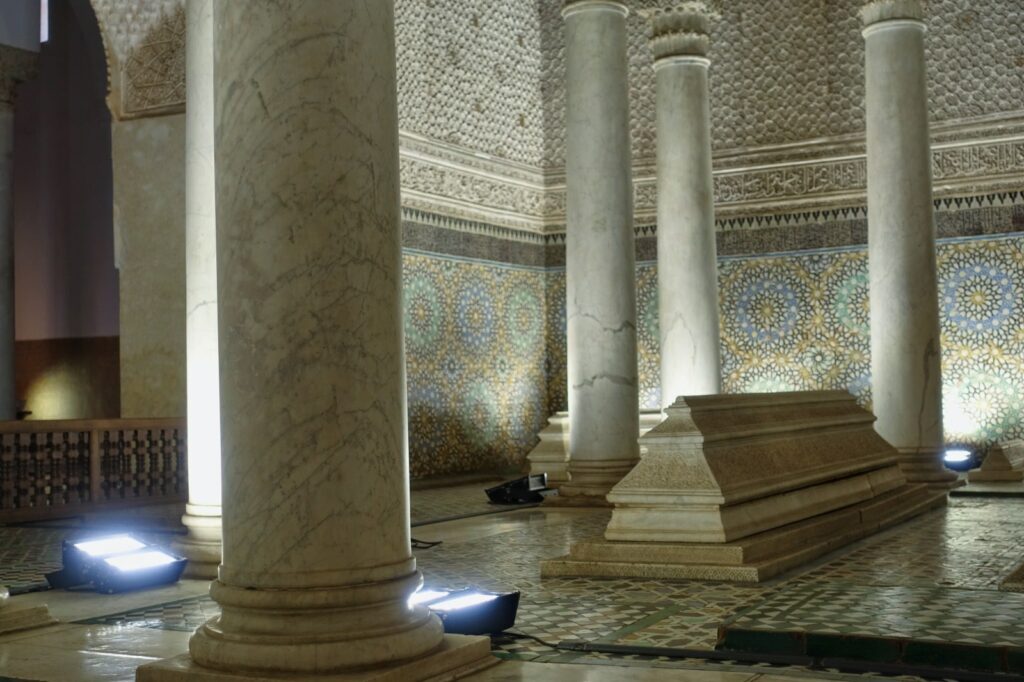
The interior of the Saadian Tombs in Marrakech features ornate marble columns and intricate mosaic tilework surrounding a central stone sarcophagus. Ground-level spotlights illuminate the detailed carvings on the walls and the polished marble surfaces of the mausoleum.

To the right and left of this impressive hall are two other burial chambers. In one room lies the tomb of the Alewid Sultan Moulay el-Yazid from the end of the 18th century and a prayer room with a mihrab. In the other room there are some children’s tombs.

Small mausoleum

Attached directly to the walls of the mosque is a second, somewhat smaller mausoleum. I find it no less impressive. Here, too, I am impressed by the cedar carvings. What artistic work, which here form a lettering below the roof. Also the gable one the lateral loggias consists of cedar wood. In this tomb one has buried family members and some officials.
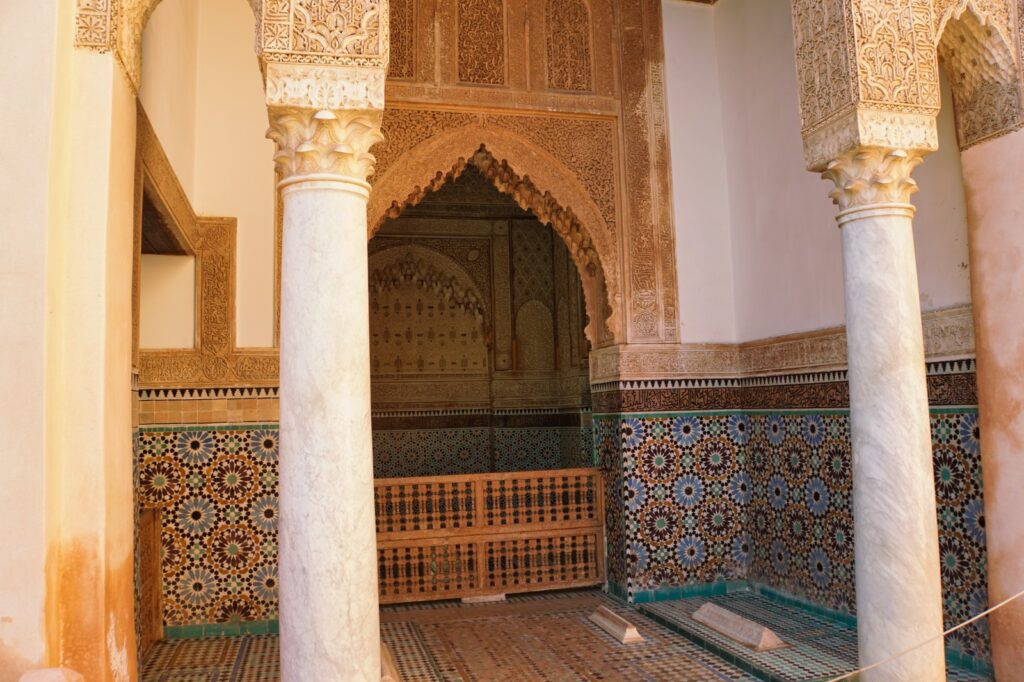
Intricately carved stucco archway and walls featuring geometric patterns and Arabic calligraphy at the Saadian Tombs in Marrakesh, Morocco.

In the well-maintained garden you can find some shady places that invite the visitor to take a break here and enjoy the impressive architecture.
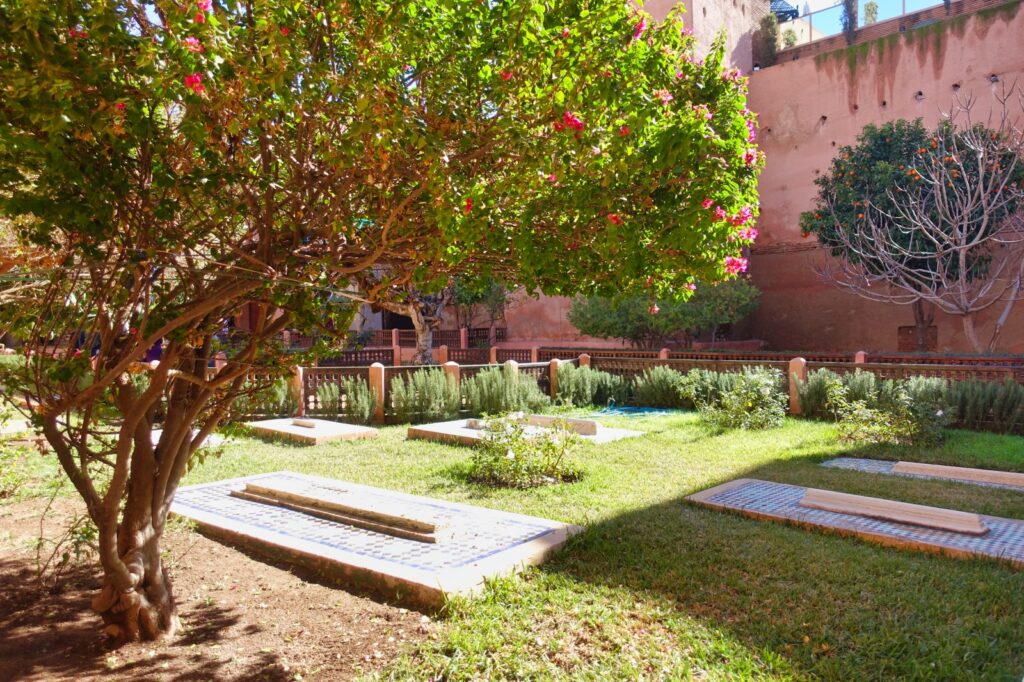
In the Saadian Tombs garden in Marrakech, several tiled rectangular graves lie on a green lawn shaded by a large flowering tree and surrounded by low hedges and a high terracotta wall.

I was very impressed by the visit to the Saadian tombs. It brought me closer to Moroccan history and the wonderful Moorish style is for me what I expected in Marrakech.

Address:

Rue de La Kasbah,
Marrakesh 40000,
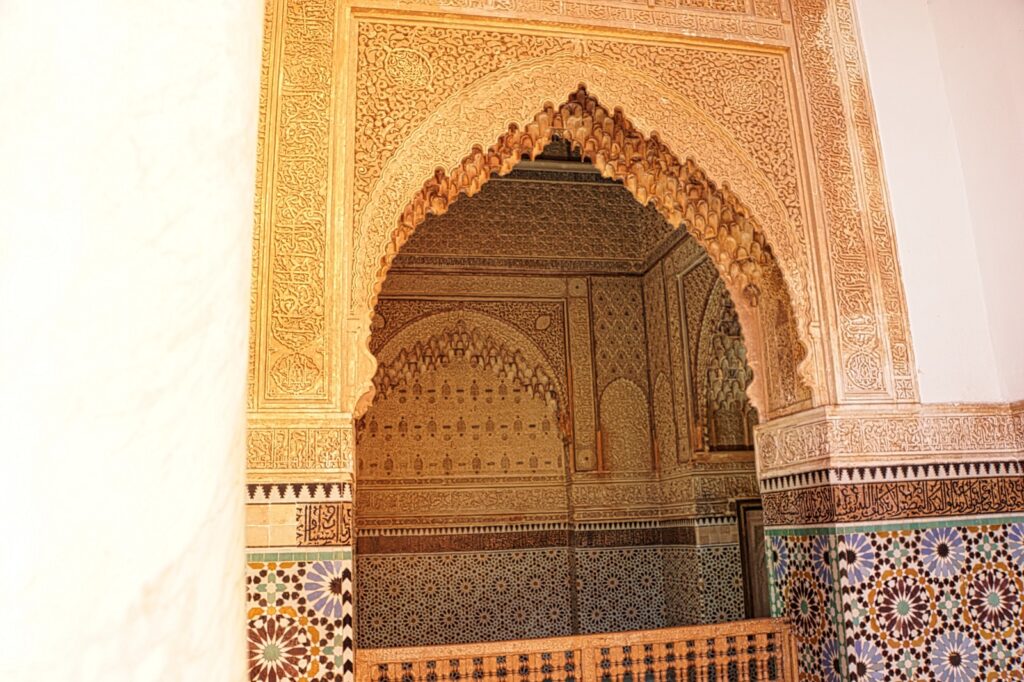
An ornate interior view of the Saadian Tombs in Marrakesh, featuring intricate stucco carvings, arched doorways, and vibrant geometric zellij tilework on the walls and floors. Two white marble columns frame the scene, leading to a wooden screen and marble grave markers within the historical funerary complex.

Opening hours:

daily 9-17

Entrance fees:

adults: 100 MAD

  • share  
  • save  0 
  • share 
  • share 

About Susanne Jungbluth

Ich bin Susanne, die Verfasserin dieses Magazins. Als Berlinerin mit chronischem Fernweh schreibe ich von faszinierenden Städtetrips bis hin zu entspannten Genusswanderungen in der Natur. Meine Reisetipps richten sich an unternehmungslustige Genießer, die das echte Leben, fremde Kulturen und gutes Essen schätzen. Begleite mich auf der Suche nach der nächsten Reiseinspiration! www.susanne-jungbluth.de

Reader Interactions

Leave a Reply

Your email address will not be published. Required fields are marked *

  • Impress
  • Privacy Policy
  • Photo credit
  • About us

Marrakech
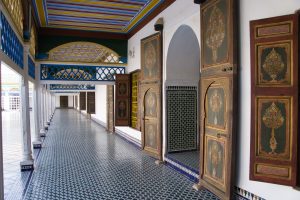
  • A view of the ornate arcade in the Grand Courtyard of the Bahia Palace in Marrakech, featuring intricate tile flooring, painted wooden doors, and a colorful striped ceiling.
    Marrakech Palaces – Bahia Palace and El-Badi Palace
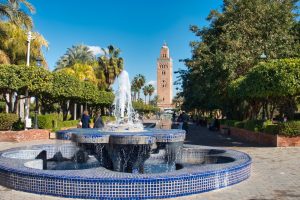
  • A blue-tiled fountain sprays water in the foreground of a lush park, leading the eye toward the historic Koutoubia Mosque tower under a clear blue sky in Marrakech.
    Koutoubia Mosque – the landmark of Marrakech
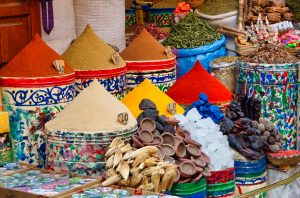
  • A vibrant market stall in the Marrakech medina displays large, pointed cones of colorful spices like turmeric, paprika, and cumin in decorative painted tins. The scene is filled with a variety of textures, including piles of dried herbs, cinnamon sticks, and traditional Moroccan goods.
    Stroll through the medina of Marrakech
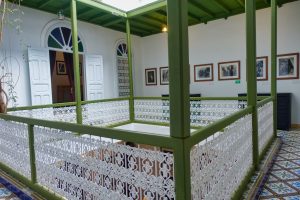
  • The upper balcony of the Maison de la Photographie in Marrakech features white wrought-iron railings and green wooden columns overlooking a central courtyard, with framed photographs lining the white walls.
    Maison de la Photographie – not only for photo lovers
More about Marrakech