250 steps. No elevator. If you want to visit the Witches’ Bridge in Wrocław, you have to earn the view with your calves first. But the sweat-inducing climb up the north tower of the Mary Magdalene Church is well worth it. At a height of 45 meters, you will not only find what is arguably the best view of the Market Square (Rynek), but also a rather bizarre legend about vain daughters, flying brooms, and a cruel witch trial.

A Structure of Power: The Wild History of the Mary Magdalene Church
When you think of magnificent churches, you often imagine peaceful places. But the Mary Magdalene Church in Wrocław looks back on a history full of rivalry, destructive fires, and eerie legends at dizzying heights.
It was not built by bishops, but by the wealthy, self-confident merchants of the city. They wanted to show: We have power, and we have money! And they did just that with a building that continues to shape the city’s skyline to this day.

The church’s origins date back to the first half of the 13th century. After a first Romanesque building was destroyed during an act of war in 1241, it was quickly rebuilt. However, with the city growing rapidly, this structure soon no longer met its demands. Following a great fire in 1341, the city’s bourgeoisie erected the present-day basilica. The wealthy merchants also financed the magnificent building to compete with the neighboring St. Elizabeth’s Church for the tallest tower and the most splendor. The Mary Magdalene Church seemed to have won the contest somewhat, as the Holy Roman Emperor Charles IV donated valuable relics to the church.

In the 16th century, the Mary Magdalene Church became the starting point of the Silesian Reformation and remained the center of the Protestant faith in Wrocław until the end of the Second World War. After severe destruction in 1945, the ruined church was extensively restored in the following decades and today serves as the cathedral of the Polish Catholic Church.
Pure Brick Gothic: The Impressive Exterior
Before heading inside, we took a look at the impressive exterior of the building. The Mary Magdalene Church is a classic example of Silesian Brick Gothic.
The 62-meter-long and 32-meter-wide basilica was built without a transept. A special historical detail on the south facade is the so-called Ołbiński Portal from the 12th century. It originally comes from a demolished monastery and was integrated into the church in 1546.

I am particularly impressed by the two massive, over 72-meter-high square towers on the west facade. For centuries they wore magnificent, copper-covered Renaissance domes, which were irreparably destroyed by an explosion in 1945. For structural and post-war financial reasons, the towers have only been fitted with flat emergency roofs since they were rebuilt. That is quite rare for such an imposing church.
Inside the Church: Patrician Epitaphs and a Chained Dragon
We reach the interior of the nave via a few steps. My tip: In front of the church entrance stands one of the Wrocław dwarfs: “Wentyl the Motorcyclist”.

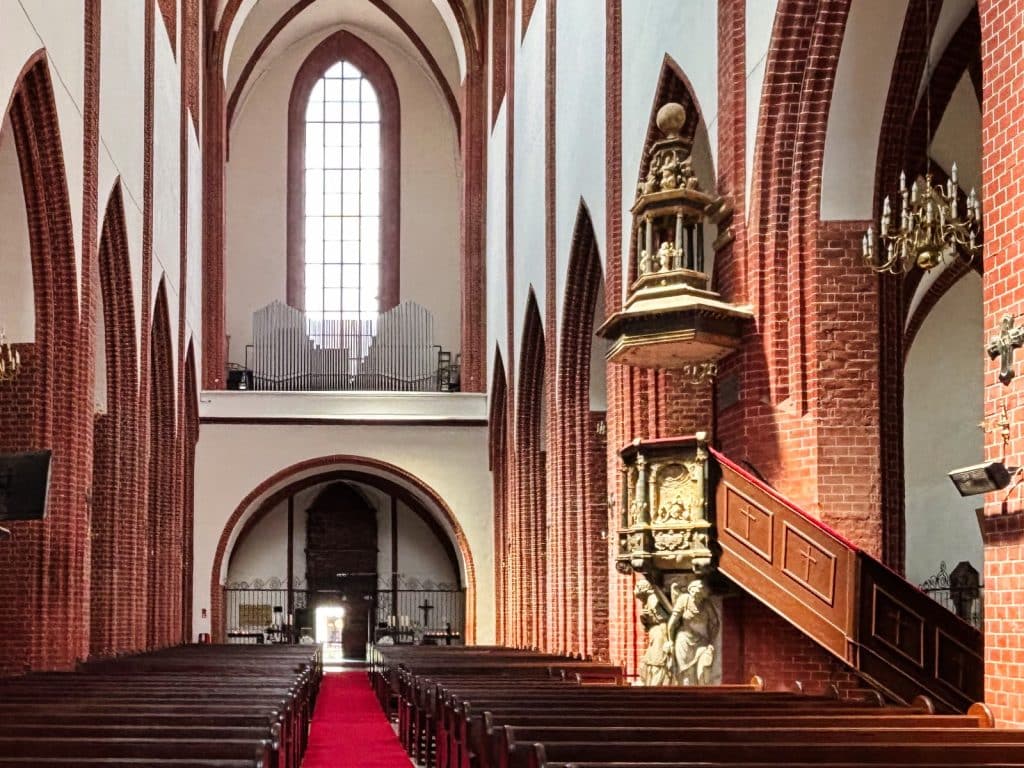
The nearly 30-meter-high main nave automatically draws my gaze upwards. At 9 meters high, the side aisles are kept significantly lower. Here once stood 58 medieval side altars, which have not completely survived today due to the changes of the Reformation and war damage. However, there are still a few beautifully preserved altar areas. Today, the church interior is adorned with numerous ornate Renaissance and Baroque epitaphs of Wrocław patrician families.

The undisputed highlight of the interior is the monumental Renaissance pulpit from the late 16th century. It was crafted from the most precious materials such as white alabaster, green serpentinite, and deep black stone. A particularly striking detail is located right beneath the pulpit stairs: the sculpture of a chained, burning dragon, which symbolizes the devil. With every step up to the sermon, the priest symbolically trampled evil.
The Wrocław Witches’ Bridge: Dizzying Heights and Dark Myths
The most famous feature of the church is probably the “Penitents’ Bridge” or “Witches’ Bridge,” which connects the north and south towers at a height of about 45 meters. First documented in 1459, the walkway once served entirely as a crossing for tower guards and as a vantage point for spotting fires. After being destroyed in 1887 and 1945, the bridge was faithfully reconstructed to its original state in 2001.
Most visitors to the church are drawn exclusively to this connecting bridge. In the entrance area of the church, you reach the ticket office and a small shop through a low doorway leading to the tower. Access to the climb is limited. When it’s crowded, it can take a while before you can climb the stairs.
The Sweat-Inducing Climb up the Church Tower
The ascent to the viewing platform on the bridge is a sporty endeavor. There is no elevator in the historic church tower. We had to conquer about 250 steps in the north tower. During the climb, information boards (also in English), dark atmospheric music from speakers, and light installations create a mystical mood on the intermediate floors. On one of these landings, we learned more about the legends surrounding the “Witches’ Bridge.”

The Legend of the Penitents: Tekla and the Witch Martynka
The best-known tale is about Tekla, a beautiful, young, but extremely vain and work-shy woman from Wrocław. Instead of devoting herself to household chores or yielding to the advances of honorable men to start a family, she spent her time exclusively in front of the mirror, flirted with young gentlemen at parties, and laughed at the idea of marriage (“Why do I need a husband?”). One day, her own father cursed her, unable to bear her frivolity and ignorance any longer. That same night, dark forces abducted Tekla and banished her to the high bridge between the towers of the Mary Magdalene Church. As punishment for her idleness, she was condemned to sweep the bridge night after night until the end of the world.

No one could hear her cries at a height of 45 meters. Time passed and she grew old and lonely in the freezing cold; her face, covered in soot and dirt, revealed nothing of her former grace. The young, kind-hearted witch Martynka observed old Tekla’s torment and decided to help. She flew down to the Market Square on her broom at night and met the wizard Michał, who was crawling around in the dark searching for his lost glasses and magic wand, without which he had lost his power. Martynka found the items and handed them to the magician. As a reward for this deed, she was granted a wish and demanded Tekla’s salvation. When Martynka returned to the bridge, Tekla had vanished. Legend has it that for centuries, mothers in Wrocław would bring their disobedient or vain daughters to the church at dusk to show them the sighing and the scratching of the penitents’ broom as a moral warning.
The Witch Trial: A Cruel Step Between Life and Death
A second, far bloodier association with the bridge dates back to the era of witch hunts. Accused women were supposedly forced to walk across the narrow walkway at an extreme height. If a woman was able to cross the bridge without stumbling and without fear of heights, the Inquisition considered this irrefutable proof that the devil was helping her and keeping her from falling. She was condemned as a witch and subsequently burned at the stake. If, however, she lost her balance in a panic and plunged to a certain death, she was posthumously deemed innocent and her soul pure.
Sensational View: What to Expect on the Bridge


Through a door, we finally reached the bridge. It is naturally not very long, nor is it particularly wide, since it was not originally designed as a tourist attraction. During our visit, there were perhaps 20 other people on the bridge with us, and it felt like there shouldn’t have been many more. So we were able to comfortably enjoy the view. It truly is a sensational view to the west (City Hall, St. Elizabeth’s Church tower, Market Square) and also to the east (Cathedral Island Ostrów Tumski, Oder Valley).
What impressed me was the view of the church roof. It is extremely steep, pointed, and covered with colorful roof shingles.

The highlight, however, are two of the famous Wrocław dwarfs that have found their place on the parapet since 2009. They represent the two figures from the legend: Tekla and the little witch Martynka. Tekla is depicted with a coarse birch broom, while Martynka is shown as youthfully bold with a pointed hat. Today, the figures are one of the most sought-after photo motifs high above the city.

Is the Wrocław Witches’ Bridge Worth It?
A definite yes! Even if the climb up the many steps is a bit exhausting, the sensational view over the Market Square and the Oder Valley compensates for every effort. The cute dwarfs Tekla and Martynka on the parapet also make the perfect photo op.
My tip for planning your time: You should plan a total of about 45 to 60 minutes for visiting the inside of the church and climbing up to the bridge. Those who come shortly before sunset not only benefit from beautiful light over the city, but can also immerse themselves particularly well in the gloomy atmosphere of the old legends.
Visitor Information
Address
Szewska 10
50-122 Wrocław
Directions
The church is located right in the heart of Wrocław’s Old Town, just one block east of the Main Square (Rynek).
Opening hours
Church Services
Sunday: 9:30 a.m., 11:00 a.m., and 6:00 p.m.
During these times, tours of the interior are limited, and access to the tower is often closed.
Witches’ Bridge
Summer Season (Apr–Oct) Hours: Daily 10:00 a.m.–8:00 p.m.
Winter Season (Nov–March) Hours: Daily 10:00 a.m.–6:00 p.m.
Admission Prices
Church
Admission to the church’s main nave to view the architecture and the pulpit is free.
Witches’ Bridge
Regular: 18 PLN
Reduced: 12 PLN
Cash and card payments accepted at the ticket office
Accessibility
Unfortunately, access to the Wrocław’s Witches’ Bridge is not wheelchair-accessible. Since there is no elevator within the historic walls of the church, visitors must climb the approximately 250 steps on their own. The climb up the north tower is therefore not suitable for wheelchair users, strollers, or people with severe mobility impairments.
In addition, you should have at least a little head for heights to walk across the narrow bridge at a height of 45 meters.
Visiting the nave on the ground floor, however, is at ground level and easily accessible.
Clothing
You should make sure to wear appropriate clothing (shoulders and knees covered) and observe the customary silence.
The visit took place as part of a collaboration with the Polish Tourism Organization in Berlin and the Wrocław Tourist Organization.
Published 27 September 2026

Leave a Reply