Corsica holiday
Corsica, the ‘Island of Beauty’ (French: Île de Beauté), delights visitors with its variety of landscapes, cultures and activities and is located in the western Mediterranean.
At 8778 km², the island is the third largest island in the western Mediterranean and although Corsica is a popular holiday destination, the island has largely retained its unspoilt nature. Many beaches, hiking trails and villages are uncrowded, so you can enjoy the tranquillity and charm of the island to the full.
Corsica offers a unique variety of landscapes that cannot be found on any other Mediterranean island. From picturesque coastlines with fine sandy beaches and turquoise-coloured water to rugged mountain ranges and dense forests – nature is at its most spectacular here. Beaches such as Palombaggia, Rondinara or Saleccia are among the most beautiful in Europe and offer perfect conditions for sun worshippers and water sports enthusiasts. The Corsican mountain range with peaks over 2,000 metres (e.g. Monte Cinto) is a paradise for hikers and adventurers. The Corsica Regional Park protects large parts of the island and is home to a rich flora and fauna.

Places such as Pigna, Sartène and Corte exude an authentic atmosphere with their narrow alleyways, traditional stone houses and breathtaking views. Ajaccio, the birthplace of Napoleon, and Bastia with its picturesque harbour offer exciting insights into the history and culture of the island.
Corsican cuisine is a delight for gourmets. It combines Mediterranean and Alpine influences and uses mainly local and seasonal ingredients. The famous Corsican cheese Brocciu, the savoury sausage specialities such as Figatellu or the sweet Canistrelli biscuits are a must-try. Chestnuts, which grow in the Corsican forests, are the basis of many dishes, from bread to desserts. Corsican honey is also known far beyond the island. Corsica offers excellent wines, such as the white wine from Patrimonio, as well as the regional myrtle liqueur.
Corsica holiday
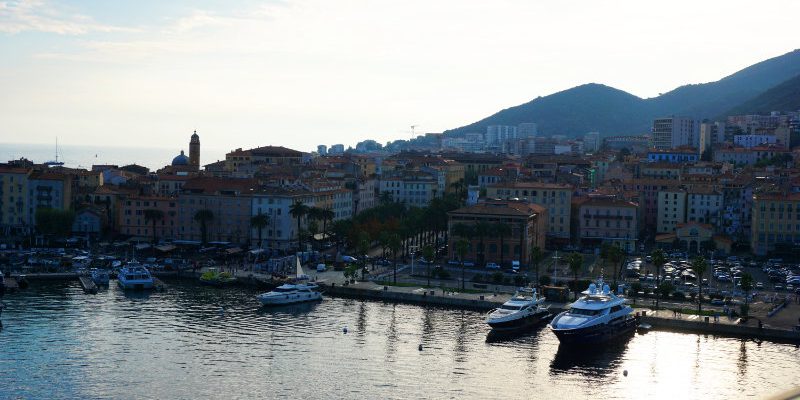
The first stop on the AidaPerla’s Mediterranean cruise is Corsica. After a day at sea, we are looking forward to our brief visit to Ajaccio.
Travel information about Corsica
Arrival
By plane
There are four airports on the island: Ajaccio, Bastia, Calvi and Figari. In the high season, there are also direct flights from Germany. However, you often have to change planes on the French mainland.
By boat
There are several ferry connections that link the island with the mainland. For example, the Italian cities of Genoa and Livorno and the island of Sardinia are served. There are also ferries to the French mainland, for example to Marseille, Nice and Toulon.
On the way in...
By car
There are only a few well-maintained trunk roads, all in the Bastia and Ajaccio areas. Most of the roads are narrow and very winding. As a result, traffic moves much slower than on the mainland.
There are numerous car rental companies. Insurance and rental prices are significantly more expensive for a holiday in Corsica than on the mainland. The “Corsica surcharge” due to the difficult road conditions is 5-10€ per day.
By bus
Due to the narrow roads, buses rarely travel into the hinterland. In the urban centres, the numerous bus lines run quite frequently.
By train
There is a small narrow-gauge network running across the interior of the island. The trains connect Bastia with Ajaccio, Ile Rousse and Calvi. The lines are only single-track and there are only a few trains.
By bike
There is no additional cycle network in Corsica. You have to use the normal roads.
Best time to visit
Spring (March to May)
In spring, Corsica awakens from hibernation and temperatures slowly rise. The coastal regions offer mild temperatures, while the mountains remain cooler. In March, temperatures on the coast are around 12-15 °C, rising to a pleasant 18-22 °C in May. There are around 5-6 days of rain per month on the coast, slightly more in the mountains. Spring is ideal for hikers and nature lovers, as the island is in full bloom and the temperatures are pleasant. May in particular is a popular time to visit, as it is not yet too hot and the island is less crowded.
Summer (June to August)
Summer is the main time to visit Corsica, especially for beach holidaymakers. Temperatures are high and the island is at its sunniest. Temperatures are between 25 and 30 °C, with slightly cooler temperatures in the mountains. July is the driest month of the year, with hardly any rain. The water temperatures are between 20 and 24 °C.
Autumn (September to November)
Autumn is a quieter time to visit, especially in September and October, when temperatures are still pleasantly warm. September is ideal for hikers and beach holidaymakers, as the sea is still warm and temperatures remain pleasant. From October onwards, it gets cooler and wetter.
In September the temperatures are 22-26 °C, in November they drop to 15-18 °C. October and November are the rainiest months of the year.
Winter (December to February)
In winter, Corsica is much quieter and temperatures are cooler, especially in the mountains where snow can fall. However, the coastal regions remain mild. On the coast, temperatures are between 12 and 15 °C.
Language
The official language is French. However, Corsican, a language with an Italian dialect, is also spoken on the island.