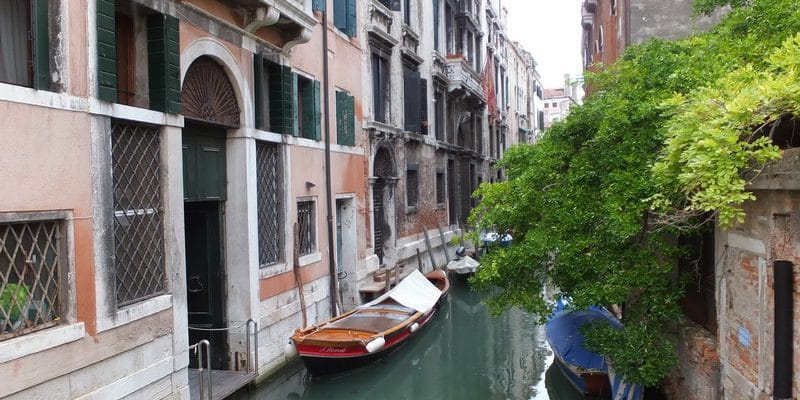
Venice - a lagoon city
Who doesn’t dream of travelling to Venice one day? The capital of the Veneto region is Italy’s tourist magnet and attracts many visitors every year.
Venice, the city of gondolas and canals, romantic bridges and magnificent palaces, is waiting to be discovered. With its unique blend of history, culture, architecture and culinary delights, the city offers an incomparable vacation experience.
Venice was a rich trading city in the Middle Ages and is even said to have been one of the richest cities in the world. This can still be seen today in its beautiful palaces. The city is a living museum of Gothic, Byzantine and Renaissance architecture, with buildings lining the picturesque canals. St. Mark’s Square, the heart of the city, is surrounded by impressive buildings, including St. Mark’s Basilica, the Doge’s Palace and the Campanile, which delights with its impressive view over the city.
The culture of Venice is rich and varied, shaped by centuries of art, literature, music and tradition. Here you can visit world-famous museums and galleries such as the Palazzo Ducale, the Galleria dell’Accademia or the Peggy Guggenheim Collection.

But that’s not the only thing that makes the city unique for visitors today. Its location is also unusual. A large part of the urban area is located in the lagoon off the mainland. The houses stand on huge logs in the middle of the water. There are no cars here, people get around on foot or by boat.
Tourist Venice is located around the Grand Canal in the districts of San Polo, Santa Croce, Cannaregio, Castello, San Marco and Dorsoduro with the island of Giudecca. The lagoon islands of Murano, Burano and Torcello and the Lido di Venezia spit are also among the city’s popular tourist spots.
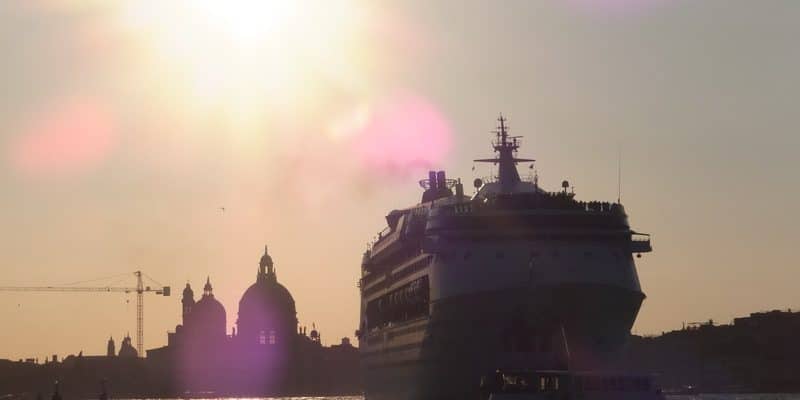
From an economic point of view, tourism is the main source of income for the city. The number of visitors has grown steadily in recent years and the streets have filled up. For the city, the burden grew to the point of pain – overcrowded streets, huge amounts of rubbish, overcrowded canals and boats in addition to the gigantic cruise ships that unload their passengers in the middle of the city every day. Initial measures are being taken to address this problem and to control tourism again.
Excursion tips for Venice
A trip to Venice is associated with romance. Being driven along the canals in a gondola, the gondolier singing softly, the sun setting…. are there any women who don't dream of it?I, too, was naturally curious about the waterways of Venice and had built up my image from the various TV films. But did that…
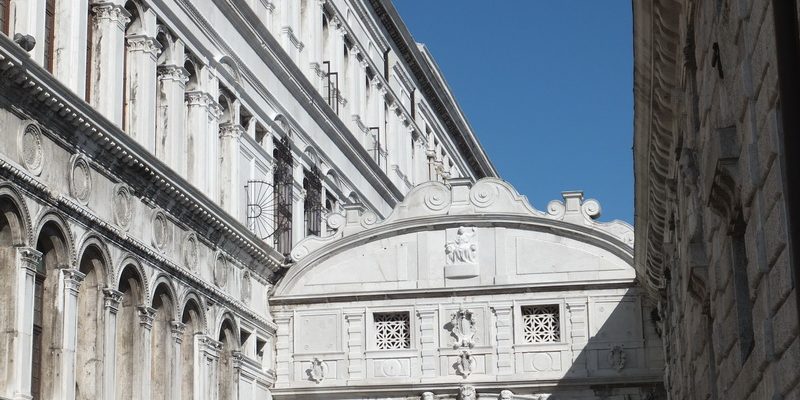
The Palazzo Ducale, Doge's Palace, is one of the most important buildings in Venetian architecture. Since the 9th century, the Doge and the governmental and administrative bodies of the Republic of Venice have had their headquarters here. The palace is connected to a prison wing via the Bridge of Sighs.
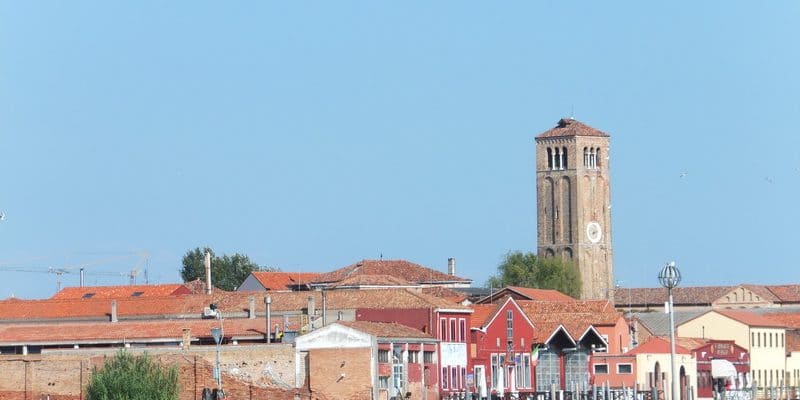
From Venice, boats regularly sail to Murano, a small town located on a group of islands off Venice. We also paid a visit to this town during our stay in Venice.
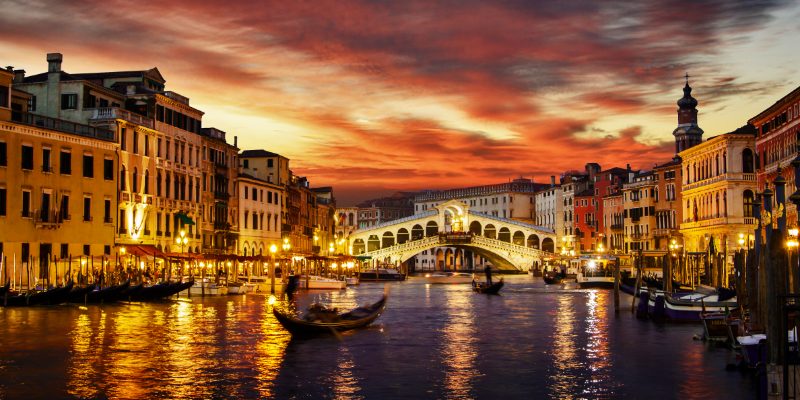
For me, the Rialto Bridge in Venice was second only to the gondola ride with a singer in the evening atmosphere of Venice in terms of romance. So I was really excited during our stay.
No, we didn't fall into a canal! But we still got our feet wet during our visit to Venice.It was beautiful weather in Venice! In T-shirts, shorts and sandals, we set off in the morning for another day of exploring the lagoon city. The destination for this day - St Mark's Square, Basilica di San…
Many visitors associate Venice with romance, beautiful architecture and picturesque canals. But is it really always like that? In any case, we were very surprised when we suddenly found ourselves in the middle of a demonstration in Venice.
Book an excursion
Travel information
Arrival
By plane
About 8 kilometres from Venice is the Venice-Tessera “Marco Polo” airport. From there you can go to the city by boat or by road. There are water taxis and water buses that are popular.
Another airport served by low-cost airlines is in Treviso.
By train
The railway stations Venezia S.L. and Mestre are served by many long-distance trains. In addition, there is the city railway station Santa Lucia, which has a connection to the mainland with a 5-kilometre-long bridge. It is located directly on the Grand Canal. The long-distance and regional trains of the Italian domestic traffic and night trains from Germany and Austria arrive here.
By bus
Local and national buses stop at Piazzale Roma. Buses operated by tourist operators go as far as Tronchetto Park Island.
By car
The old town of Venice is car-free. Those arriving by car must park their car on the mainland. Garages are available for a fee at Piazzale Roma or on Tronchetto. These are close to the centre, but are also quite expensive.
If you park a little outside, you can find cheaper parking spaces and then take the train to Venice.
For long-term parkers, it is worth using the parking spaces near the airport and then taking the free shuttle to the boat dock at the airport.
By ship
There is a cruise terminal in Venice. There are ferry connections to Greece, Croatia and Slovenia.
On the way in Venice
By car, train
In the historic centre there is no possibility to travel by car, train, bus or bicycle.
By bike
Cycling is not allowed in the streets and squares of Venice’s old town. Violators may be fined. However, cycling is a good way to explore some of the islands of the Venetian lagoon, for example Lido, Pellestrina and Sant’Erasmo.
On foot
The historic centre can be explored very well on foot. There are about 400 bridges with stairs in the city, leading over the numerous canals.
On the water
Transport in Venice takes place on the water. Vaporetti (regular waterbuses), water taxis, private boats and gondolas operate here.
The cheapest way to get around is on the vaporetto lines, which connect all the main towns. Here you can buy single and day tickets. For more than 3 trips a day, the day ticket for tourists (Tourist-Travel-Card: Biglietto Turistico a Tempo) is worthwhile.
Water taxis allow for a customised tour, but are also much more expensive.
A little less known are the traghettos, a kind of gondola ferry that crosses the Grand Canal. The ride is very shaky due to the waves, but also inexpensive. There are 5 places between the train station and St Mark’s Square where a traghetto crosses the canal.
List of the different gondola ferries:
Santa Sofia – Mercato di Rialto
from 1.10. to 31.3. from 7.30 – 18.30
from 1.4. to 30.9. from 7.30 – 19.00
San Tomà – Sant’Angelo
from 1.10. to 31.3. from 7.30 – 18.30
from 1.4. to 30.9. from 7.30 – 19.00
Santa Maria del Giglio – San Gregorio
from 1.10. to 31.3. from 9.00 a.m. – 5.00
from 1. 4. to 30.9. from 9.00 – 18.00
Riva del Carbon – Riva del Vin
from Monday to Friday, from 9.00 – 12.00
Punta della Dogana – Calle Vallaresso
from Monday to Thursday, from 9.00 – 12.30
The traghettos do not run on public holidays, 25 and 26 December, 1 January and 15 August; on 24 and 31 December the service will end at 13:00.
A ride on the typical gondola in Venice seems romantic. However, you should be aware that they often travel a predetermined route in a long line. The prices for about 30 minutes are around 80,-€ and only in rare cases you use the gondola alone. Mostly 6 people are transported at the same time.
Best time to visit
Spring (March – May)
In spring, Venice enjoys mild temperatures of 15 to 20°C, making this a pleasant time to visit. However, spring is also a rather rainy season, with rain showers occurring frequently. It rains 6 to 8 days per month and the average rainfall is around 50 to 70 mm per month.
Summer (June – August)
Summer in Venice is warm and relatively humid. Average temperatures are between 23 and 28°C, although temperatures can often be higher in the city’s narrow streets. The average rainfall is around 60 to 80 mm per month, and there is an average of 6 to 9 rainy days per month. July is the sunniest month.
Fall (September – November)
Autumn is one of the best seasons to visit Venice. The humidity is less than in the middle of winter, and although it rains a lot during this time of year, September, October and November are ideal months to visit Venice. It should be noted that flooding can often occur in the fall.
Winter (December – February)
In winter, the average temperature in Venice is between 5 and 10°C. It is a cold and wet season, but the influence of the Adriatic Sea mitigates these conditions somewhat. The average temperature in winter is between 7 and 8 degrees.
Aqua alta
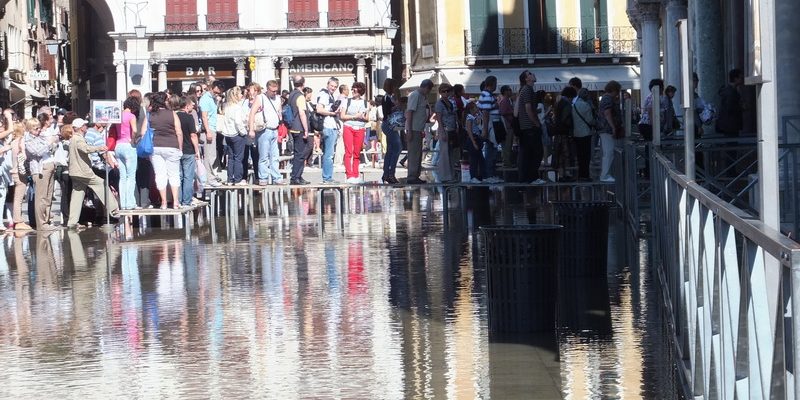
Aqua alta is the name given to the floods that occur in Venice. Since December 2007, there has been a siren warning system that can be heard throughout the city. To be prepared for the water level, you should listen to the following:
-
- a height of 110 cm above normal level – one tone
-
- a height of 120 cm above normal level – one tone + one higher tone
-
- a height of 130 cm above the normal stand – one tone + two higher tones
-
- a height of 140 cm above the normal stand – one tone + three higher tones
From a height of 95 cm above normal level, the water buses will gradually stop running. From 140 cm, no vaporetto will operate.
In the city, footbridges are set up from 110 cm water height, on which one can move. From 140 cm, these have to be dismantled again, as there is a danger that they will float away.
It is advisable to get rubber boots at Acqua alta.
Admission prices and visitor's tax
Entrance fees
From 2024, visitors to Venice who are not staying overnight in the city will have to pay a daily fee of EUR 5 per person. This regulation applies to all persons over the age of 14. Children under the age of 14 and residents of the Veneto region are exempt from this fee.
The entrance fee must be paid online via the official website.
Overnight guests who already pay a tourist tax and commuters are exempt from the entrance fee.
Anyone found in the old town without a valid “Venice ticket” risks a fine of between 50 and 300 euros.
In 2024, the entrance fee will only be charged on certain days.
You will only ever pay admission between 8:30 am and 4 pm. If you enter Venice before 8.30 a.m. or after 4 p.m., you will not have to pay an entrance fee.
- April
April 25 to 30 - May
May 1 to 5
May 11 and 12
May 18 and 19
May 25 and 26 - June
June 8 and 9
June 15 and 16
June 22 and 23
June 29 and 30 - July
6 and 7 July July
July 13 and 14
Tourist tax
The tourist tax in Venice varies between 1 and 5 euros per person per night, depending on factors such as the time of year, location and classification of the accommodation. Children under the age of 10 and people with disabilities are exempt from the tourist tax, while young people between the ages of 10 and 16 receive a 50% discount.