Wadi Bani Khalid – freshwater pools in a green oasis
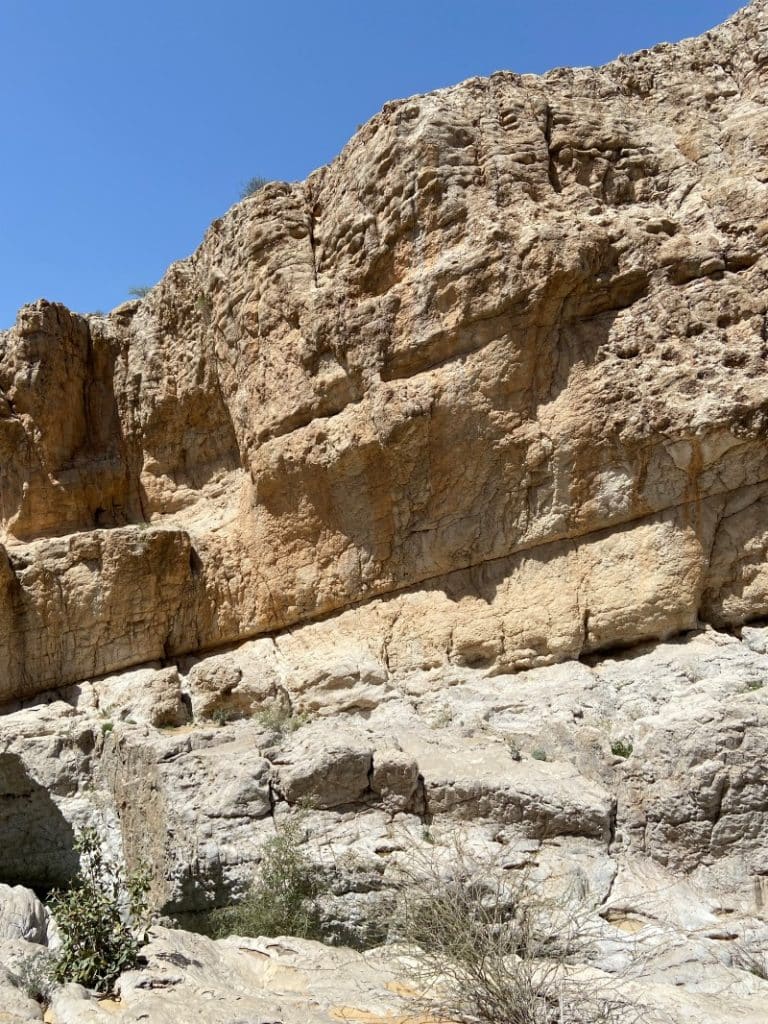
We head into the mountains… the off-road vehicle winds its way up steep roads and the landscape around us becomes increasingly barren. A half-day excursion lures us into one of the most beautiful wadis in Oman, the Wadi Bani Khalid.
Wadi Bani Khalid is located around 150 kilometers southeast of Muscat. It is the most famous wadi in the Shamal ash-Sharqiyya district of Oman and is located in the Hajar Mountains. The wadi is well developed for tourism and is one of the most popular sights in the country.
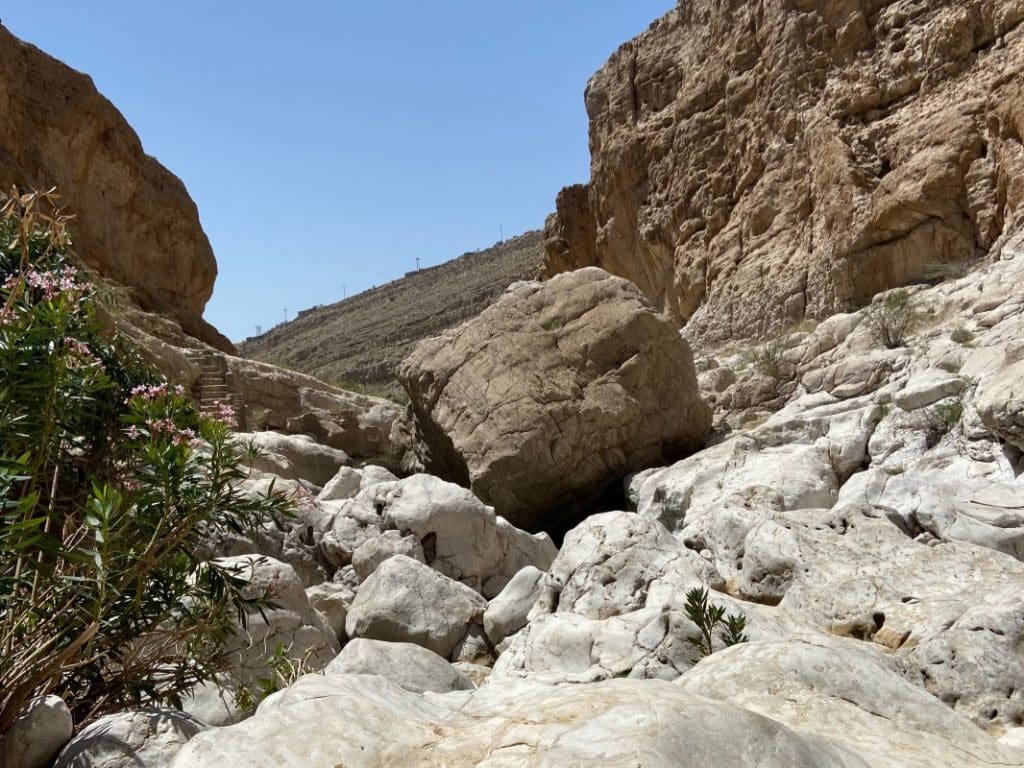
The road winds uphill through bizarre rock and mountain landscapes that present themselves in the most beautiful colors and shapes. The drive is a real pleasure and I can’t get enough of the beautiful landscape. Most of the access road is very well maintained. A few sections were washed out by the recent rain during our visit and construction work is underway there.
We easily reach the large visitor parking lot, from where we can explore the valley after a short walk. If you can, you should avoid visiting Wadi Bani Khalid at the weekend – i.e. Friday and Saturday. Then it can get really crowded, as many Omanis use the place as a local recreation destination!
What is a wadi?
A wadi is a valley or river course that can be found in desert areas in North Africa and the Middle East, for example. There are also wadis in Oman. Many of these valleys emerge from the mountains and end in the sea. In the mountains, they are mostly narrow, rocky areas with trees, shrubs and palm trees. The further you get towards the sea, the drier the wadi becomes and is sometimes only recognizable by small green oases and the washed-out riverbed. Some wadis carry water permanently, during dry periods in small quantities, while other wadis dry out completely.
Wadis can become particularly dangerous when it rains in the catchment area. It can then happen that the dry wadi turns into a raging river within minutes. Especially if the terrain is not clearly recognized as a wadi, this can have serious consequences for those unfamiliar with the area, resulting in repeated fatalities.
We were in Oman about a week after the rains and in some wadis in the mountains we could clearly see the traces of the rains: in a positive sense – it was beautifully green, in a negative sense – some roads were washed out and impassable even with an off-road vehicle.
Where is the Wadi Ban Khaild?
With a length of over 150 kilometers and a catchment area of over 4000 square kilometers, the Wadi Bani Khalid is the most extensive river system in Oman.
It carries the water from the easternmost part of the Hajar Mountains southwards into the Arabian Sea, in contrast to other wadis that carry their water northwards into the Gulf of Oman, such as Wadi Tiwi, which has its sources only about five kilometers away from Wadi Bani Khalid.
The first settlements are located in the upper course of the wadi, after which the freshwater pools form at Muqal. From there on, the riverbed is surrounded by vegetation and water sources emerge even during dry periods, which has led to the founding of settlements such as Halfah, Bidah, Sayq and Sabt.
The wadi then flows through a wide plain between the Hajar Mountains and the Rimal Al Wahiba sands, where it forms a wide, branching riverbed that flows around the area of Al Kamil Wal Wafi. The most populous villages, including Jalan Bani Buhassan with 20,000 inhabitants and Balad Bani Ali with 30,000 inhabitants, are located in the lower middle reaches. Towards the end of its course, the wadi is mostly dry and there are no further settlements.
Short walk
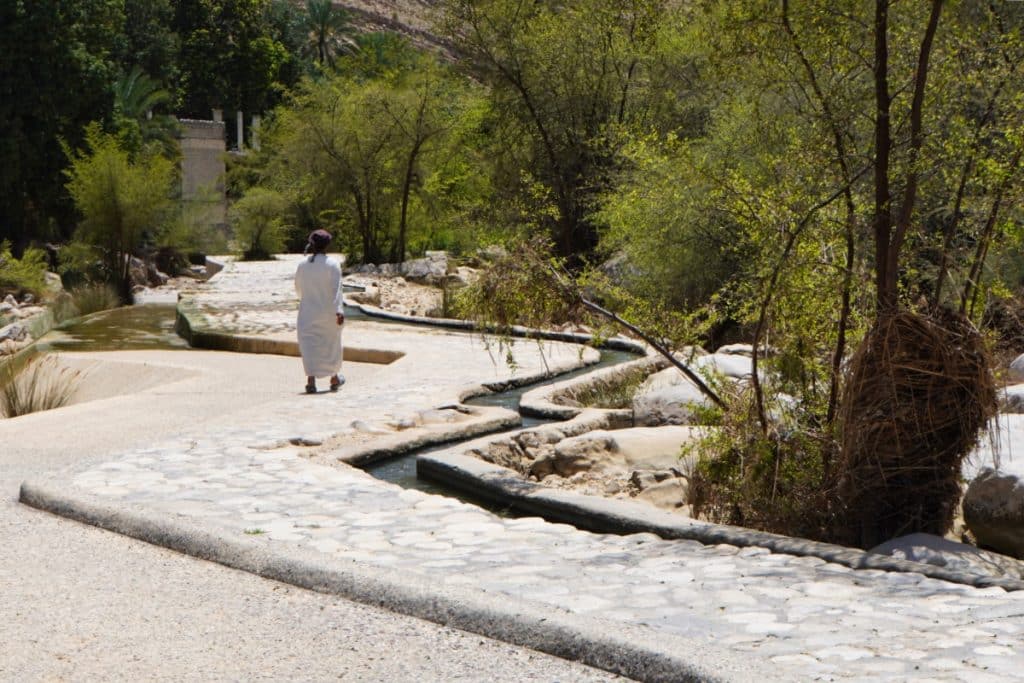
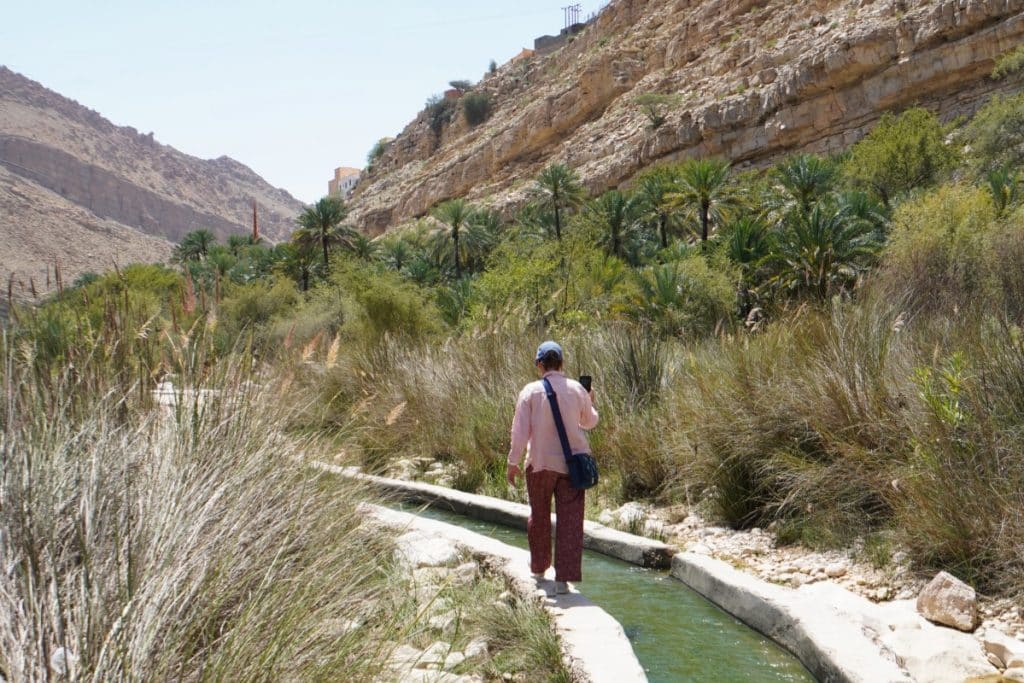
Once we arrive at the parking lot, there is no chance of getting lost. There is only one path leading into the valley! Along a small canalized watercourse, we balance on the wall further into the valley. Plants grow all around us, it is green and the air is very pleasant despite the heat. Later, we continue on unpaved paths between palm trees, trees and bushes that provide wonderful shade and every now and then I hear a donkey in the distance.
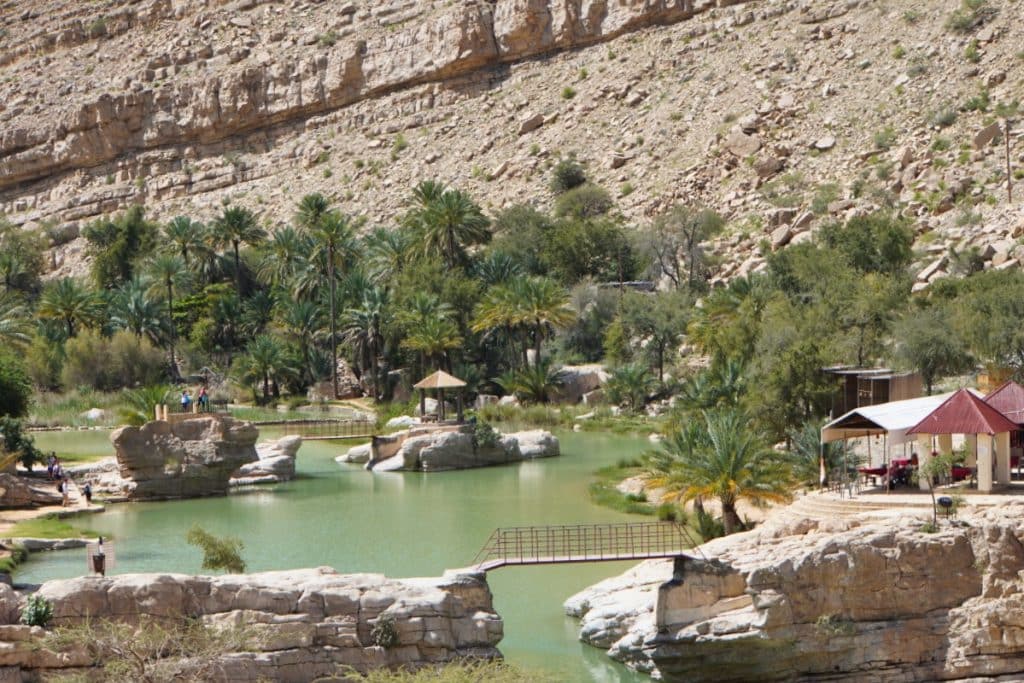
You are never alone here. The Wadi Bani Khalid is one of the most popular wadis for tourists and certainly also because it is well developed. Here you will find toilets and a restaurant that offers a wonderful view of the large rock pool. Tour guides take their groups around and show them the best places to swim.
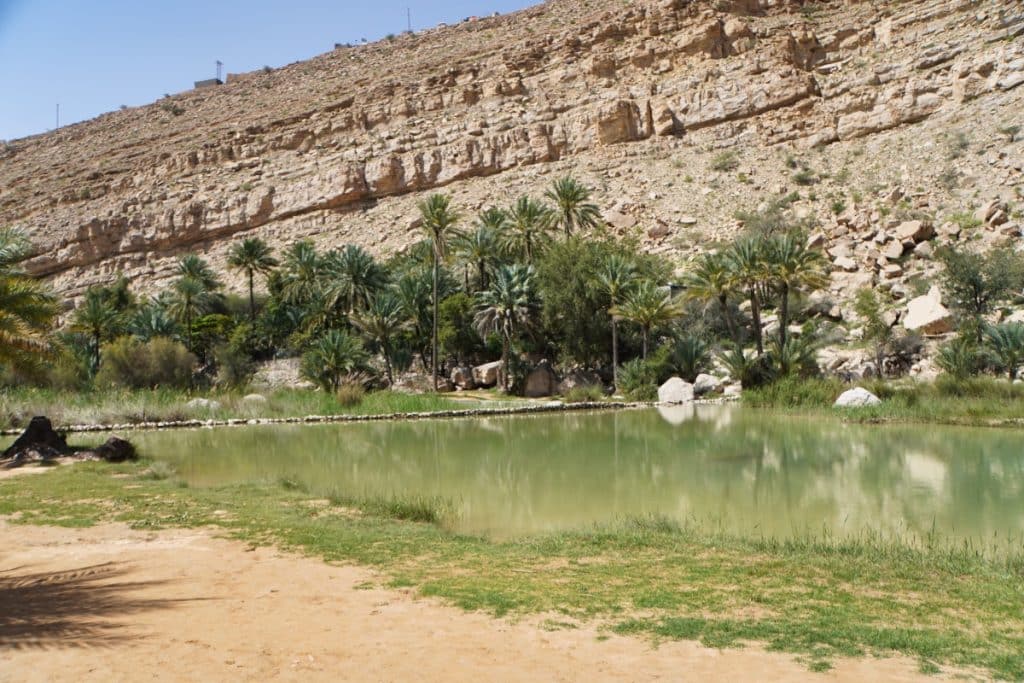
We wander through the green oasis landscape until we finally arrive at the first large rock pools.
Swimming allowed!
Swimming in the rock pools is permitted in the wadi. However, visitors should bear a few points in mind if they want to get into the cool water:
It is not desirable for visitors to change directly at the pool. If you want to slip into your swimsuit, you can change in the restaurant toilets. I also saw two small tents in a rocky alcove that are rented out by enterprising Omanis.
This is a public area in an Arab country. This means that vacationers should also adhere to the customs and traditions of this country. Signs indicate that everyone should wear T-shirts and pants (up to the knee) when swimming. During our visit, many visitors adhered to this, with some wearing at least a T-shirt over their swimsuits.
Swimming is at your own risk. There is no lifeguard here, no stairs to get you safely into the water. You climb over stones, which can be very slippery, into the refreshing but not cold water!
Even though the water is very clear, it is difficult to see ledges and depths. A sign at the entrance warns against jumping into the rock pools.
Rock pools in Wadi Bani Khalid
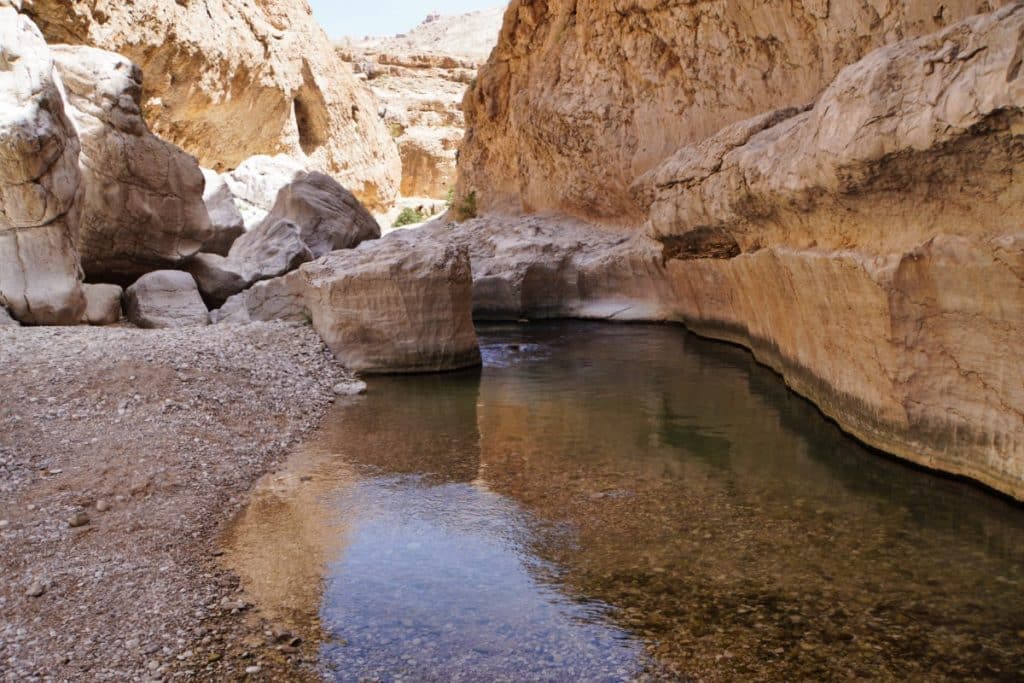
When we reach the rock pools in Wadi Bani Khalid, we are faced with two large main pool areas. It is usually very busy here, as many visitors don’t want to climb over the rocks to get to the smaller, quieter pools. In high season, people sit here on blankets in the shade, children splash around in the water and those who want to can swim under a bridge. I was amazed at how big this area is, you can swim really long distances here.
Wadi Bani Khalid is a popular excursion destination for Omanis. Many families come to the valley, especially at the weekend, to enjoy a break between the palm trees and mountains. When we visited Oman, however, it was very quiet here. Only a few tourists and almost no Omanis were out and about during Ramadan. I found it wonderfully quiet and very pleasant.
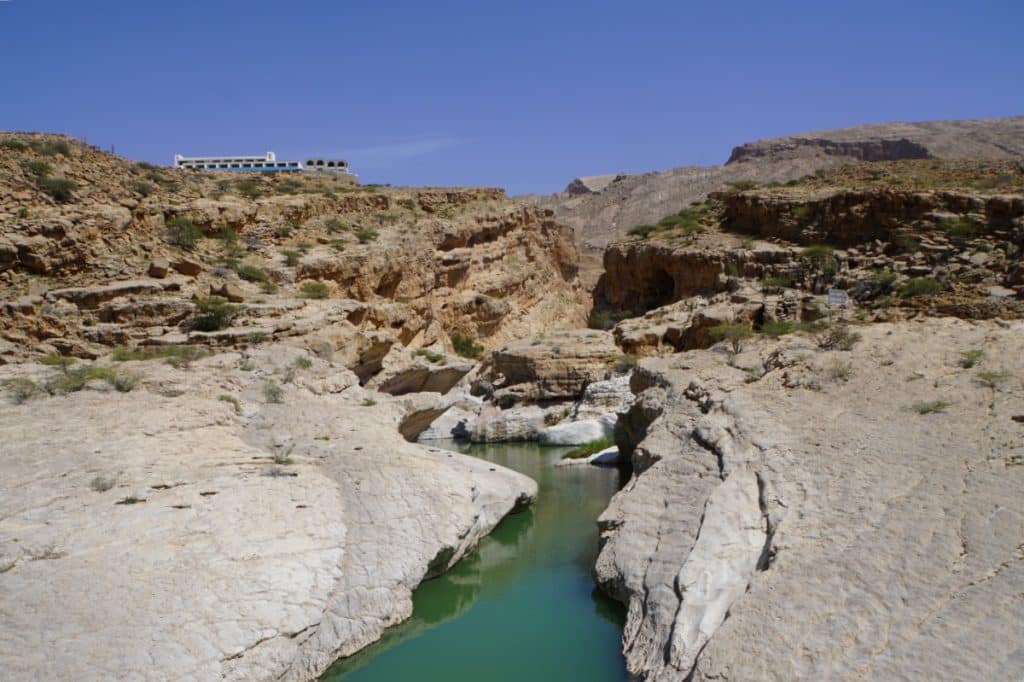
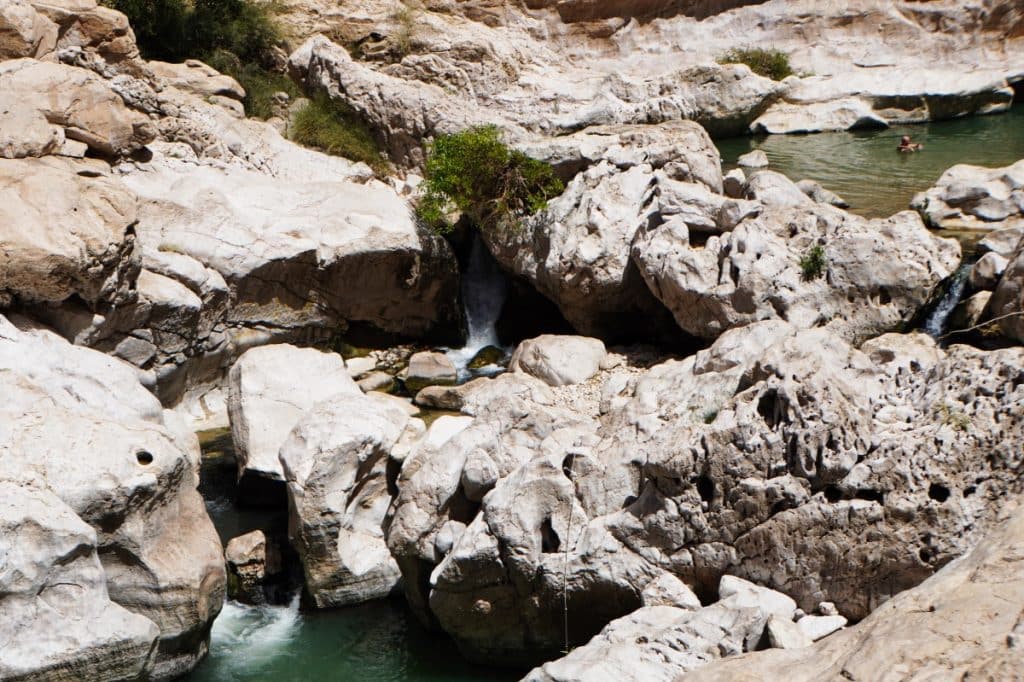
After walking for about 10 minutes along an uneven rocky path, we reached the smaller rock pools. These are connected by small streams and the odd small waterfall.
There were a few swimmers in the water here, but not so many as to disturb each other. We swam, dived, relaxed and enjoyed the beautiful natural surroundings in the small rock pools. We looked for a quiet spot on a rock and sat there for a while thinking. What impressive places there are in the world!
We continue to the Muqhal cave
A sign lured us onwards. In about one kilometer we should reach a cave. We were confused after just a few meters. A path was not really visible and we were unsure whether we should really climb between the rocks. However, as always and everywhere in the world, there are friendly young men (who are naturally keen to earn some tips) who are there to help. Our new “guide” climbed with us over rocks, led us across watercourses and hopefully showed us the easiest way. In some places I was admittedly quite glad to have a helping hand. The wet stones were slippery and the path was not easy. But it was fun and we had the Muqhal Cave as our destination.
Finally, we stood in front of a huge rock with a tiny entrance that would take us into Muqhal Cave. The entrance was narrow, shallow and didn’t really look inviting. Even though the young man assured us that the cave would quickly get higher and we could stand, Patrick immediately pulled the emergency brake and stopped in front of the entrance. I tried it and slid down the rock into the cave, sitting on my bottom. It was so shallow that I couldn’t even sit up straight. A look inside the mountain showed me a muddy room that didn’t really look inviting. You could see that water had flowed along here a short while ago. And at that moment, the masses of rock seemed to crush me and I made a hasty decision to head back.
I don’t want to judge whether it’s worth climbing into the cave. We were told that bats live in the caves and that their behavior has not yet been affected by tourists. One thing is for sure, you should wear sensible shoes and take a flashlight with you if possible. It was quite dark.
Good to know
How do you get to Wadi Bani Khalid?
Wadi Bani Khalid is located around 200 km from Muscat, the capital of Oman. You can usually get there by car or on a tour. The roads are well developed, but the last section to the wadi is winding. A 4×4 vehicle is not essential for the visit.
What should you bring with you?
Visitors should bring swimwear, sun protection, comfortable shoes for easy hikes, plenty of water and perhaps a picnic. A camera is also essential to capture the spectacular landscapes.
When is the best time to visit the wadi?
The temperatures are pleasant from mid-October to mid-March. However, you should avoid driving there directly after a rainy day. If it is not possible to get there, the police will close the access road.
Is it allowed to swim in Wadi Bani Khalid?
Yes, it is permitted to swim in the rock pools. Please wear a T-shirt and knee-length trousers in addition to your swimwear and do not change in the open air.
Are there entrance fees?
Access to Wadi Bani Khalid is free, but charges may apply for certain on-site services.
Are there any catering facilities?
There is a restaurant that offers local dishes. However, it is advisable to bring snacks and water with you.
The visit to Wadi Bani Khaid was part of the program of a tour with Zahara Tours.






Leave a Reply